About

The goal of the Linux-Society (LS, dating back to the mid-90s as a professional club and tech-mentoring group) has been a purely-democratic Information Society; many of the articles are sociological in nature. The LS was merged with Perl/Unix of NY to form multi-layered group that included advocacy, project-oriented learning by talented high school students: textbook constructivism. Linux has severe limitations such that it is useless for any computer that will, say, print or scan. It is primarily used for webservers and embedded devices such as the Android. (Google is high-invested in it).

Technology is problematic. During the heyday of technology (1990s), it seemed it had the democratic direction Lewis Mumford said it should have in his seminal
Technics and Civilization.

Today, we are effectively stuck with Windows as Linux is poor on the desktop and has cultured a maladaptive following. Apple is prohibitive, and all other operating systems lack drivers, including Google's Android, an offshoot of linux.

In the late 90s there was hope for new kernels such as LibOS and ExoOS that would bare their hardware to programs, some of which would be virtual machines such as Java uses. Another important player was the L4 system that is a minor relation to the code underlying the Apple's systems. It was highly scientific but fell into the wrong hangs, apparently, and has suffered from having no progress on the desktop. There is a version, "SE" that is apparently running in many cell phones as specialized telecom chips, but is proprietary. SE's closed nature was only recently revealed, which is important because it is apparently built from publicly-owned code as it is not a "clean room" design it may violate public domain protections, and most certainly violates the widely-accepted social contract.

Recent attempts to enjoin into L4 development as an advocate for "the people" have been as frustrating (and demeaning) as previous attempts with the usual attacks to self-esteem by maladaptive "hacks" being reinforced by "leadership" (now mostly university professors).

In short, this leaves us with Windows, which is quite a reversal if you have read earlier posts here. But, upon Windows, we have free and open software development systems in the forms of GTK+ (the windows usually used on Linux) and the Minimal GNU Windows (MinGW and MSYS) systems. It is very likely this direction that development should go (that is, on Windows) such that s/w can then be ported to a currently-valid microkernel system that includes a driver system that can be adapted by hardware developers to reuse of their windows and apple drivers.

From a brief survey of L4, it appears that the last clean copy was the DROPS system of the early 2010s, was a German effort that used the Unix-like "OS kit" from an American University.

If we are going to be stuck on Windows, then it seems that a high level approach to free and open systems integration, such as creating fully transparent mouse communication between apps so that they can seamlessly work together as a single desktop (rather than deliberately conflicting). This would be very helpful for GIMP and Inkscape, both leading graphics programs that are strong in the special ways, but suffer from an inability to easily interrelate.

Another important issue is the nature, if you can call it that, of the "geek" or "hack." Technology is formed democratically but "harvested" authoritarian-ly --if I can coin a term that Mumford might use. Authority is plutarchy: a combination of aristocracy and oligarchy that is kept alive after all these millennia by using, or maligning, the information society as a part of the civilizing (or law-giving) process that embraces the dialectic as its method. Democratic restoration, that is to put humanity back on an evolutionary (and not de-evolutionary) track, I think, will require the exclusion of the "geek" from decision-making. As is, the free/open s/w culture attempts to give leadership to those who write the most lines of code --irrespective of their comprehension of the real world or relationship with normal users. We need normal people to somehow organize around common sense (rather than oligarchic rationalism) to bring to life useful and cohesive software and communications systems.

Interestingly, the most popular page on this site is about Carl Rogers' humanistic psychology, and has nothing to do with technology.


Monday, December 29, 2008

Obama's Environmentalism Embraces Destruction

Obama's "changes"
Obama is bending towards both labor and the environment, but there are "rubs" in his approaches. To many, he is appointing the old guard; his appointments are not symbolic of
change. This article attempts to show that Obama's support for the environment is support for hunting, that hunting is effectively anti-environmental, and hunting is in fundamental ways connected to our present economic disaster. I want to help influence Obama to move his
administration in ways that help him fulfill his promises to make America solid and safe for everyone, and hence improve the world. I hope he will be president for both terms, and perhaps again after a four year wait.

Obama's "changes" to the economy, as an example
Obama promised to eliminate the "trickle down theory" in his final and most important election speech, but he is still attempting a pure capital approach, albeit modified, to restore the economy (which as a resource exploitation system is anti-environmental by definition). What he fails to realize is that the "trickle down theory" is precisely how capital works, and capital is our system, unless he decides to develop alternative ideas. In capital, resources are accumulated in central
locations called capitals, and benefits from this accumulation "trickle down" to the society through the filter of the bank accounts of the very wealthy and their holdings, traditionally called trusts. From what we can see, Obama is very deliberate in his support for bailing out these "trusts" now that they are failing despite their history of terrible effects on both the general population and the environment. If this were actually a free market economy, as Obama's economic advisers say it is, then these losing "trusts" should be allowed to fail to be replaced with economic components that work.

Obama's "changes" for the environment
He is pulling together the environmentalists that support hunting, proven by his appointment to protect the environmental, pro-hunting Sen. Ken Salazar of Colorado as Secretary of the Interior. The Sierra Club endorses Salazar, which brings up the issue that many environmental groups support hunting; these groups are influencing Obama.

Hunters drive bulldozers destroying forests
It is the hunting community that drives the bulldozers that knock down the trees to build subdivisions and malls: the two greatest threats to natural habitat. All bulldozers in this type of construction are driven by men wearing camouflage baseball caps: a symbol of hunting.

Once I when I was driving a concrete truck near Savannah, Georgia, I saw a family of small ground birds in a state of pure panic; they were a group of chicks being led by their mother in circles around a newly constructed house. Their home, or habitat, had been destroyed to build
"McMansions." The scene made me very sad and I wish now that I had photographed their plight. The forest had been their home perhaps for hundreds of years, and was being destroyed by unfeeling Southern contractors, who are most likely hunters.

I had taken this mixer truck driving job while I was finishing my degree. I poured concrete mostly in subdivision construction sites, though I originally expected that I would be working on building factories, and hence creating jobs. The subdivision work was exceedingly hard on my left knee as I was required to work the heavy-duty truck clutch constantly for hours while filling slow-moving curb extruders for subdivision streets. While pouring in these subdivisions I was continually saddened while I saw Latin American illegal labor creating huge bonfires more than fifty feet in height from the beautiful Georgia forests that had been destroyed the hunter-driven bulldozers.

It is this real estate speculation that now fuels endless habitat destruction; and real estate speculation is at the core of our present national economic disaster. In the early 2000's, US technology and manufacturing were ransacked and the money was invested in sub division
and shopping mall development; when the money ran out, credit replaced it. And now we are in a "credit crunch." At the core of the "credit crunch" is a financial instrument called the "credit default swap," or CDS, which is an "equity traded" insurance policy instrument for questionable loans. The institutions that insured the poor loans, including AIG, did not have the liquidity to support the defaulted loans (and hence the term "credit default swap") and went into the
red. The first action by Treasury secretary Henry Paulson's "bail-out" was to shore up the financial institutions who issued the CDSs, especially the very guilty financial insurance company AIG.

In these paragraphs I try to show the relationship between hunting and finances; I try to show that habitat destruction, the destruction of our environment, is closely related to the destruction of the economies of the world, and that Obama's intended changes may not really be changes at all, but a series of corrections to preserve the system that is destroying both the US economy and world's environment. And this despite Obama's best wishes to repair America and positively influence the world.

Hunting is a hateful sport
Hunting is a reactionary, or even "KKK," type of sport--few if any true liberals hunt, urban or rural. And Obama is a Black American. Because of this obvious contradiction, I feel the design behind his environmental strategy is probably not his, and this gives me hope that his environmentalism can be set on a proper, more empathic, track. I believe that this strategy has been architected over may years by insidious insiders occupying key policy making positions in the environmental movement: Pope of the Sierra Club is my primary example. I only learned very recently of environmental support for hunters when I saw Pope's endorsement of Salazar as Interior Secretary, where Pope specifically mentions Salazar as a hunting supporter.

After many experiences meeting hunters in the woods, I personally see any contact with them in isolation as potentially suicidal. Threats by one of them during a hike a decade ago drove me into the arms of animal activists. I have come to know them as people who enjoy killing, and have found that they often align with reactionary causes; If I had been born a Black American, my fears of dealing with hunters would increase by factors.

Instead of supporting hunting as environmentalism, Obama needs to look to great naturalists for advice, especially John Muir who founded the Sierra Club. Muir, along with my favorite writer Lewis Mumford, was disgusted by hunting. Social scientists and film makers who "embed" into tribally native cultures have shown a natural and empathic relationship with the forests by the Natively Tribal: our original human society. Cultural advancement has been away from the "blood model," which is more closely related to the ancient empire builders, and towards our roots. Look at the art in modern art museums, such as the cubists. The music of the world is increasingly tribal and full of love; the only popular hate-based music today comes from Nazis or is influenced by cocaine and crack. Even the hunters' children are all dancing to African strains in Hip-hop--there is much to be hopeful for!

My personal advice for animal activists is that they should encourage empathy in the mainstream, especially within the communities of compassion. Animal activists should go to church, for instance, and celebrate the blessing of the animals on St. Francis day. There they can see that most people are animal lovers, even conservatives. One third of the US goes into forests to appreciate nature peacefully and reverently, whereas the hunting community, which only goes into the forests to kill, is only a very small percentage. Furthermore I have found that most hunters are not actually core hunters, but simply friends of the hunters "along for the ride." They are joining their friends in the hunt mistakenly thinking that hunting is a natural human tradition.

Many environmentalists are confused by this undemocratic gap; Captain Paul Watson of the Sea Shepherd Society wonders how such a small percentage controls the nation, or perhaps even the world. The reason seems obvious to me; core hunters are well-armed and they obviously like to kill; they have unlimited access to ammunition. The general population is scared of them. Hunters, and other killers, are in the military where they have weapons of mass destruction; many are in police departments that allow them "reach out and touch" anybody they want with little, if any, accountability.

Obama needs us to support his promises
What Obama promised (which I believe he had to promise to beat McCain) is unprecedented change, and I believe that this level of change is desired by the vast majority of Americans. I showed that the pro-hunting environmental strategy cannot possibly be his, and I believe that few, if any, of his strategies are original; he is simply building his administration with strong available people and system components that are believed to work. Many of us are wondering where the changes will be. Many here on OpEdNews say "wait and see," while many are already disgusted and want to protest with radical activist strategies.

I think our best approach is to be critical, analytic, and to the point. There is no question in my mind that the necessary components for constructing a solid and safe America, and hence an improved world, are with us right now--we just have to look for them in Science and history. We need to find them, build on them, and refine them through our own peer review, and then submit them as serious work to policy makers--especially the big policy-maker:
President-elect Obama. From experience I suggest that the more radical submissions begin with a conciliatory introduction.

Citations and other supporting information
I very much want to get this kind of information out as quickly as possible while the administration's "concrete is still wet."

Also important to this article is the newly developed research connecting humanity to the
natural environment with empathic neurons, and also the history of hate and killing in hunting documented by Lewis Mumford in Technics and Civilization. I will also use this as the basis for bigger writing (click here).

"Bad guys" that he has appointed include former Iowa governor Tom Vilsack for agriculture and former fed chief Volcker as economic adviser. Vilsack helped build the universally hated confinment factory farms, and is said to be a puppet of Monsanto. Volcker, a former Fed chief, is every bit as stupid as his Fed chief successor, Alan Greenspan.


AFTER NOTE: The above writing above supporting Obama but decrying "false" environmentalism was submitted to OpEdNews.com as an article. Rob Kall, who owns OEN, specifically asked me to bring environmentalism to OEN, and then he, or someone there, rejected the writing. I sent him a response with more information supporting the capital connection to hunting and environmental destruction, but it was sent back to me, well, to be rid of the hunting connection.

The term hunting should bring back to many policitals the image of Cheeny shooting his friend in the face with a shotgun at a "canned" duck hunt. So my question to Rob Kall is "why protect hunters, of all people?"

Below is information supporting the hunting / capital connection coming mostly from my own experience, but supported by the very important late Lewis Mumford, who wrote Technics and Civilization.


My motivation for writing the article is to support OEN by creating a link between OEN and Care2.com, which is at the moment experiencing an exodus. Care2 is populated primarily by people seeking to protect the environment, and who actively support love over hate.

I tried to create relationships between topics that would enjoin the two groups, and I "tarred" a lot of people, including hunters, but most specifically the capital structure.

I am fully willing to remove references to the KKK from the article, but the article attempts to show reactionary support for the present trends of economic destruction, which were supported by Bush.

This is something that Obama clearly needs to eliminate to succeed, even survive, as a Black American president. There are daily arrests for assassination attempts against Obama coming from people who clearly have KKK thinking.

The basis of the present economic destruction is the conversion of the American economy from manufacturing and technology into house construction. The economy failed when many very bad housing loans came due, causing a 50% shortfall in corporate values, which is held
in the equities market.

Mass destruction of environmental habitat occurred as a result of the housing boom as well; that destruction of environment was done by hunters driving bulldozers; that I saw as a concrete mixer driver. If I had not seen it happen, I would have assumed it because I understand the rural relationship with the environment.

You asked for "empathy," and here it is. And you also asked for a connection to Care2; I am trying to build that with this article.

This information is pivotal to making the connection between OEN and Care2.com.

My personal area of study is how the human environment interconnects with the natural environment, and that is the study of empathy from the evolutionary perspective. (http://thinman.com/empathy)

The criticism surprised me. I have never met anyone else, who protects hunters, except hunters themselves. Urban people hate them because they kill for joy, which is viewed as related to hate. And rural people are afraid of them them because they occasionally kill
hikers, walkers, and joggers "accidentally."

I spent most of my life "on the fence" between hunting and anti-hunting, but was forced by a hunter into the anti-hunting camp about a decade ago when he threatened my life, and rationalized it because I was not wearing orange. That event initiated my life as an environmental activist.

The criticism says "Are some hunters borish and stupid? Clearly. All? No way"

I never implied that hunters are stupid, and I don't know what the other word means. If anything I believe that they are cunning, which requires intelligence. I am saying that they are unfeeling with respect to the environment, which is what allows them to destroy habitat without feeling remorse, and hence contribute to the housing glut that caused the liquidity shortfall that is the present recession moving towards a depression.

I know that there is widespread understanding that hunters go into the forest only to kill and this can easily be supported. And from what I have seen, most writers make an assumption that those who kill for sport are unfeeling, especially Liberals.

This makes the criticism appear to come from the Right. Do hunters support war and a high use of the death penalty? That is easily supportable. Do hunters support Bush's and McCain's desires for endless wars? That is also easily supportable.

So why protect hunters?

I have spent a lot of time observing the rural right wing during my two years as a trucker. My co-driver for a year was a former Klansman who, by the way, now drives with an Black American. I don't want to hurt rural conservatives, I want them to change -- and so does
president-elect Obama. Promoting these changes may also help protect Obama from assassination.

Tuesday, February 12, 2008


Notes from emails from Gernot Heiser about L4 and Education

The importance of investing into school kids cannot be underestimated, although I see them as the future technologist, not a free work force.

Particularly in the present situation where in many industrialised countries kids are losing interest in technology and science. If this trend continues we will create a society with a very strong class structure, where the majority has no understanding of technology and limited access to its benefits, and even less understanding of its dangers. Needless to say, this is also a big threat for the economic competitiveness of those countries.

I have been tangentially involved with outreach activities at UNSW. And the scary thing is that in high school, it is essentially too late. The kids have already decided whether they are interested in science and maths, and those who have decided they don't like it are essentially already a lost cause. Regrettably, this is particularly true with girls, who at this age are very sensitive to peer pressure, and are being told by their peers that maths isn't a girl thing. In Australia, there are also studies showing that high school career advisers are also discouraging girls from science and engineering.

Essentially, the battle is already lost in high school, it has to start earlier. Our experiences with running workshop for year-five pupils (especially girls) are much better, they are still open at this stage. This is the time where the interest needs to be nurtured.

The observation that "systems research is irrelevant" has been made before by Rob Pike (http://herpolhode.com/rob/utah2000.pdf) and indeed, OS research was by many considered dead a few years ago. This isn't the situation at the moment, though. For one, Linux has changed the game by making OS code much more accessible, students can now again do research on real systems. Then virtualisation has created a lot of interest and activity in OS issues. However, Rob's observation that people are still largely using the same 40-year-old technology is still true (and virtualisation is essentially used to hack around the limitations of broken operating systems).

The reality, though, is that some of this is the inevitable result of the commoditisation of PCs, and the resulting huge inertia in the basic architecture, processor as well as OS. I don't think there's much hope in changing the PC world in the foreseeable future.

Embedded systems, however, are a different ball game. The embedded systems industry, in different verticals at different times, is realising that they have reached the use-by date of their RTOS technology. Hence they are forced into a change of OS technology, and this is the chance to put in something that's good. I sure believe that this is L4, and that's the reason we have set up Open Kernel Labs.

Saturday, January 20, 2007

Why Linux is Failing?

It isn't, look at this graph from LinuxDevices.com:


Linux rules the roost. But if you go in the street, ask any average person if they know what Linux is. I guarantee they will tell you they don't. I have been asking most of my online friends and they don't know what it is. To most people, the Internet was invented by Bill Gates; they love Bill Gates, he wants to cure AIDS.

Gates did not of course invent the Internet, in fact he accepted it in 1995 only after he realized that his CD ROM strategy for data control was going to be quashed by the open systems. Micro$oft then quickly changed tact with the "where do you want to go" campaign; what they really meant was they wanted to get a slice of every Internet transaction. In the big numbers they keep losing, but on the desktop they win. Why ??

On the Internet, the LAMP configuration: Linux / Apache / MySQL / PHP (and sometimes Perl) also rules the roost in its area, the World Wide Web. For unknown reasons precise statistics are not available for LAMP as for Embedded Linux but these figures are provided comparing Microsoft IIs and Apache (free and open) Web servers:

Apache 62.96%
Microsoft-IIS 24.94%
(April 2006 Netcraft Survey Highlights)


(thanks to OS Data dot Com)


I recall seeing last year that free and open PHP (Personal Home Page) Server presented 40% of Web server pages to the Information Society. Last year was an odd bad year for PHP, but they have recovered in the last quarter. The graph shows PHP climbing steadily. I would love to discuss PHP, as it seems both perfectly designed yet hopelessly crippled, and I will in the future.


(thanks to php.net)

In others the free systems are the most influential in the world, but pure greed organizations like Micro$oft are continuously fleecing the world while damaging everybody's good intentions.

Also important is a close look at the Bill and Belinda's Gates Foundation. They are involved in AIDS; a good question is why they picked AIDS. The future of medicine is in the modeling the human body at the cellular level. Only systems like the Google search engine and the NOAA weather prediction system can do that; they run huge networks of Linux PC class servers. Curing AIDS will also take a huge open effort to accomplish.

There is no way in hell (or Hell?) that anything coming out of Microsoft's Redmond or Bangalore authoritarian control structures is going to accomplish that. My personal experience with Microsoft OS products is that they still require daily rebooting, which is unacceptable for super computing environments.


(thanks to OS Data dot Com)


Microsoft has 26% of the Web server software market share 60% of defaced Web sites run Microsoft Web server software
(thanks to OS Data dot Com)


Obviously to me is that Bill's (and his wife Belinda's, lol) involvement is to prevent Linux from solving the world's worst crisis, and with it all disease. Also, the openness of Linux is a direct threat to the very neuro-programming of Gate's mind. He comes from a culture of greed and competition, even among his family members. Linux and Apache come from a culture of synergy, and as we now know, empathy -- which seems unlikely if you know the un-empathic history of science. I should mention that I see the Bill and Belinda Foundation to be nearly the same as the Ronald McDonald House; a horrific corruption of the concept of the meme. In the case of Ronald McDonald and his "house," a child's cartoon character is used to link the high fat beef patty with both generosity and happiness; the use of a hospitality house to further the effect I find particularly repugnant. High fat food typical of the McDonald hamburger is singly the biggest killer in America.

Linux is everywhere now, all the the little micro OS's in all the little smart devices are now Linux. The Embedded Linux reporters are having trouble bringing human interest to the embedded Linux story because all the embedded Linux developers are sworn to secrecy by the non-disclosure agreements of their investors and other owners.

The question is, "what is going wrong with Linux then, why is it still unknown?" What is the open community doing to keep itself so secret? Why is Microsoft pulling so much money while having such a small effect? I discuss that below, and the overall economic arrangement, and also a cultural approach. But first I want to try to explain these strange happenings in Linux.

First you have to know that Linux is what is called a monolithic operating system. What that means, is that all the software within the system that allows the system to interact with various hardware devices, has to be compiled within the system. Every time you want to add capabilities to a Linux computer, to run different hardware, you have to recompile the key operating component of the operatingsystem: the kernel.

The other kind of system is called a micro-kernel operating system which has a much smaller control system for which software to control the hardware is added to it to as it is needed, usually by the people who make the hardware; the kernel does not need to be recompiled to add capabilities; within the free and open software movement there was a legendary battle between the two concepts: monolithic and micro kernel. On the monolithic side was LinuxTorvalds the inventor of Linux; on the micro-kernel side was Andrew Tannenbaum, the inventor of Minix.

Both were wrong as it turns out. Linus, despite revolutionizing the world by setting technology free in a way that can only be described as a phenomena, actually was wrong in utilizing the monolithic model, that is if you believe that Linux should be popular with the masses. Tannenbaum screwed up in a purely social way; instead of offering his Minix to the world as an operating system which everyone can use to their benefit, he created it as a vehicle for his Dutch university teaching program. Who made the bigger mistake? Obviously Tannenbaum did by low-balling his own child, but we suffer from both their mistakes. Tannenbaum today is attempting to undo his mistake by offering Minix, as Minix3 a decade and a half later, as a world solution. Well, it still isn't stable, and at the bottom of the Minix3 web page (one of the most uninteresting on the web) is an ad for the Dutch university that Tannenbaum teaches in -- nothing changes.

In the two industries that Linux is succeeding in elimininating the competition (server and super computer systems such as Google and NOAA, and embedded systems such as robotic systems, refrigerators, and kiosks) the monolithic kernel is not a hindrance. In the big server systems additional peripheral hardware is seldom added, and what hardware is used of the vanilla variety: disks and communication devices. In embedded systems, the same conditions exist for the most part, and when the odd peripheral device is added by a technician, that technician is given a new operating system "image" which is installed into the system along with the hardware upgrade.

Completely left out of this scenario is the common computer user. In the Linux monolithic kernel scenario, the average person that you know, your family members, are expected to recompile a kernel, which is every bit as complicated as it sounds. There is no place in the Linux environment for the average user. And unfortunately there is no available talent to effectively create and popularize a micro-kernel operating system.

Interestingly, Micro$oft has used the micro-kernel architecture since it became multitasking with Windows 95 (http://www.osdata.com/oses/winxp.htm). Mac OSX is a micro-kernel version of the original free high quality operating system: BSD.

In the end, Micro$oft wins with its joke of a system, while we open and free systems advocates are forced to continuously fail. Understanding the culture causes of this failure takes soul searching. I happen to be personal friends with many of the important people in the free and open, or public domain, software culture, and I am familiar with all the rest. I respect and admire them, but I have wonder what the hell is the matter with them. Why do they deliberately fail? Why do the put others on the line to fail? I try to answer this below.

The answer I believe is in the history of technology, science, and control. Computer scientists, as are all scientists, are high paid servants, effectively upper caste slaves. Even when they are not paid, as in the public domain software industry, they are neurally programmed to be servant/slaves.

Why do they lack enough self-respect to undo this condition and become celebrants in their success? Again the problem is in their neurological programming. Those chosen to succeed in the system are chosen through a process called "human capital." At a young age, children are filtered by society the world 'round for specific roles in life, usually at middle school age. Those testing to be very intelligent are pushed into scientific roles, for instance, and those testing stupid will work at factory machines or be cannon fodder for the army.

Those chosen by the human capital system to be scientists are chosen based on intelligence tests. What is missing from intelligence tests is the human ability to model systems -- to use the imagination. This use of the imagination is now, neurally known, as empathy. Scientists who have succeed through the human capital system, which is all scientists, have no empathy. Because of this science lay in the gutter for nearly all of recent history; until recently science did nothing for the common person; it only slaved people in factories, destroyed the environment, and started wars. There was, for instance, no social science. And there certainly is little preventative medicine for the average person. Also there is no incentive for the truth, as scientists need incentive for every little thing; they lack the empathy to know that the truth is moral and correct.

In the US this system started to change in the 1960's with the development of educational principle such as the new math, where problem solving teaching techniques replaced what is called didactic framing, or rote learning. America, or course, became the premiere nation in the world, though individual income continually reduced. In the 90s steady intellectual and information systems growth brought the US, us, to the peak of world existence, and the we tumbled.

Clearly three things caused this: the largest stock swindle in history -- Wall Street's "pump and dump" tech crash of 2000; the Muslim extremist attack on the World Trade Center on 9/11/2001; and finally the shipping of the American technology industry to Hindu nation of India, and the Communist nation of China by US corporate executives.

Now, the US is declining in a spiral of ignorance administered by what is called the "No Child Left Behind" act of congress; the initial strategy of NCLB was to replace the biological science of evolution with the religious concept of Creationism. This was achieved in Texas through an odd annexation of this insanity to the neighboring state of Arkansas. There was actually a period of months, where Bible study replaced biology in science classes; it was struck down in the courts.

When we discuss all these problems, and especially invoke the concept of "insanity," we are obviously referring to the lamest of lame duck presidents, George W. Bush. What we need to understand, however, is that all these problems may exist for us anyway even if he and his brother, Jed (or is it Jeb?) Bush, had not corrupted the vote in Florida, giving the presidency instead to some other democratic authoritarian.

Lewis Mumford is probably the most important writer of our post-modern age. In his Technics and Civilization he predicted the tech swindle of 2000, even though he had no way of knowing that there would be such a thing as the Internet. In 1937 he said that the next major innovation would be accompanied by the greatest swindle of all time; he showed how every innovation had been accompanied by a stock swindle as long as there have been stocks, and he just drew a simple graph. He showed how RCA was the first great information system stock swindle; that figured into the great depression greatly. He just did some simple math.

When Mumford tired to talk about the future of technology, he could only talk about the past. The reason is because we live in the past; the control structure of the ancient Egyptian empire, "the first machine was built from human parts," is how the systemic structure is constructed; the ancient Roman empire dictates how business operates: "a diffuse tribute collection system, for which there is no point of interaction, and therefore no accountability."

These two empires are gone yet still alive; so let us search for other one to five thousand year old cultures that may be affecting us in purely violent and financially disastrous ways. Two in particular jump out at us everyday as they are in the news constantly for their "eye for eye, tooth for tooth" strategy of eternal conflict. These ancient cultural forces figure in at least two of the three hits America took causing the recent dive. One of these cultures, being a lot more clever than the other, is responsible for both the "cyclic rotation" (the official term for the tech crash), and the shipping of all US cash to the nations of India and China. The root cause of the third problem, the obvious dishonesty of the American executive, is a tougher nut to crack. That seems to be a product of human capital, where human capital runs parallel to didactic framing education. Which nations promote didactic framing and human capital. Germany is often mentioned, clearly all nations describing themselves as "Latin," as descendants of the ancient Roman Empire operate didactic framing through Catholic education. A major problem in the US is of course the influence of the bigotry of the KKK, and that could be a link; Germany revitalized the KKK in the 1980s by exporting to the US Neo-Nazism racism, just as Castro had emptied his prisons into Florida. The Klan, and slavery, were of course conceptual frameworks imported from European nations which had been preserving Roman concepts of slave economies. And, as the world's puppet, the US has been preserving the idea of a slave economy; even in the 1950s and early 1960s Southern writers stated that the only economy for the South was a slave economy. In 2006, as a concrete truck driver, I personally saw a resurgence in what I would call slavery; the implementation of willing and voluntary Mexican slave-type labor under Southern capital control, apparently backed by foreign investment (most likely with American capital given away by whom??).

Then when we study outsourcing, we stumble on yet another ancient empire: the Hindu upper-caste. I leave that one to you. I should also mention that I see Chinese culture as Confucian, a philosophy which confuses respect for fealty creating a population ripe for slavery-level exploitation, giving China the global edge in the downward spiral of making the wealthier even wealthier.

What is the answer to all these Information Society problems?? I also leave that to you, but I warn you the answer also lies in solving the world crisis of globalism: the Earth is a planet that can only regenerate to support one half billion to one billion people: we now have 6 billion, with the top one percent of these people benefiting from consumption of ninety-nine percent of the world's resources. I leave you with Mexico, the top illegal drug transport center, or centre, and Iran, the top illegal opium producer. And the United States, the top producer of naivete. Anybody know any killing jokes ??

Thursday, December 14, 2006

Spiritual Darwinism :: Scientific Buddhism


This writing evolved into a paper for my degree for which I made a website CLICK


The empathic research pathway has led me all the way back to Aristotle along multiple paths (who would have thunk it?). Darwinism has its roots in Aristotle's approach. Also, as I started reading about Buddhist psychology through the writings and speeches of the Dalai Lama, the term eudaimonia, often meaning leading a good, clean life-- key to the Buddhist escape from suffering. This term, eudaimonia, is linked to Aristotle, I discovered, through -- of all things -- a speech by Dr Timothy Leary. From the Dalai Lama's perspective, eudaimonia implies a psychology that is about discovering the person and making positive changes, especially with the backdrop of the environment. The other approach, what the Dalai Lama would call Western, what I call cold, involves collecting facts from studies and applying them indirectly, and usually unsuccessfully, to therapy.

aristotle and phyllis


These, and other related writings, are leading me closer to a verifiable link between the basic human thinking and feeling facilities (fortified by the new neural research), with local communities (through community knowledge), to the natural environment that we come from (through evolution).

It seems that the paper will have alternate between data collected from the newer studies which I present in as raw a format as possible (so that the readers will be forced to believe the astonishing research), with a series of introductions to the concepts as connectors embedded in between the scientific data.

Major linking information includes writing by David Suzuki about tribal elders, and also a Native tribal document about "historical trauma" that shows how the separation of the Native cultures from the environment damaged the Natives the most. This document shows how the reconnection with nature and the natural community of knowledge is the cure for the inherited trauma disorders lingering since the genocides that ran from the colonial era through to the early 1900s.

In a sense this creates a tight loop against which I can compare cold science-- replete with concepts now proved to be false, such as the greedy gene. I also have examples of animal torture tests done, amazingly, to prove empathy-- showing how much of science can be the most extreme form of stupidity. This stupid, cold science affects us all because it provides much of the data with which didactic teaching is framed, a cognitive approach which does not necessarily, by design, provide students with the truthful concepts. It corrupts society at its very basic learning point: late childhood.

In studying Buddhism, I am finding a positive tool which seems like a form of selfishness. It creates an easy path for an Buddhist towards the concept of self-preservation. Buddhist monks are often former family men-- who abandoned their families, along with their native community of knowledge, for the community of knowledge of the monks-; the Buddha himself abandoned his family. This runs contrary to the concept of empathy and love benefiting the community especially in the evolutionary sense, yet Buddhism is greatest religion of empathy.

And Buddhism goes farther with this selfish concept; it allows for self-actualization in the extreme-- the preservation of self through self-defense with martial arts when we are being threatened. This concept links closely with the aggressive Native rights movement in North America. Both Buddhism and the Native movement create defenses against the destruction of the community, the community of knowledge, and the environment. Buddhism effectively teaches us how to protect constructed knowledge.

The Buddhists promote the concept of the protection of constructed knowledge; the evolutionary approach to nature shows us how constructed knowledge is part of our past and part of the environment, and the Native studies that I am reading prove that humanity needs the environment to survive psychologically and socially.

Unfortunately much knowledge comes from what we lose, in the case of the knowledge learned from the Native tribes comes about from the loss of 90% of their population along with their culture. Much of neurological knowledge comes from the loss of mental abilities in humans, usually from brain trauma. Hopefully, with new research methods such as being used to prove empathy in the mind, empathy in society, and the empathetic link to the environment can be proved through therapeutic positiveness and cultural restoration.

Most religions oppose the idea of aggressive self-defense, rather they prefer to confuse pacifism with cowardice; promoting capitulation to destructive powers. As Mumford points out, religious leaders very often have financially driven agendas. Current global strategies especially oppose self-preservation, promoting capitulation in the face of centralized corporate and multicultural onslaught. In fact they are so certain of their global reach, that they consider the concept of self defence not to be just suicidal, but insane. The terminology revealed by corporations and economic consortia reveals a strategy combining global governance with corporate citizenship; it is reminiscent of the ancient Roman empire and it includes no individual expression in the democratic process. No where in any economic study, especially the study of the psychology of economics, is there any mention of the environment, nor is there any mention of the need to preserve or restore community knowledge. What corporations and economists prefer is the bulldozing of all that precedes them, with the replacement of all those who oppose them. The preservation and restoration of the community of knowledge is nearly purely a tribal, spiritual, and educational idea.


dennis banks, AIM movement


While the tone of the paper is not militant, it is not hard for a reader to get wrapped up in the local struggles of Native peoples everywhere when learning about the suffering Native tribes have experienced, while considering and the benefits of their nature-based knowledge. It so happens that my present sources for tribal information are both Canadian; David Suzuki teaches genetics in Vancouver, BC, and the tribal restoration movement is also in Canada.


The one difficult relationship to be proved in the paper, is that connecting the empathic abilities we experience as humans, with the need for the community of knowledge as the tribal Natives are seeking to restore. A related and equally difficult connection to make is that of the evolution of empathy in nature with spiritual faith: the basis of religion. One source I have found which provides some empathetic linkage with nature is in studies of tribes that are not made up of people-- but are made up of animals. One is a monkey tribe from Puerto Rico, which operates purely synergistically, without possibility knowing who Ruth Benedict is; and the other is the wide reaching tribe of elephants of the world who seem to be rebelling against the pains inflicted by humanity: the elephants seem to be delivering payback to humanity-- they are doing something Goleman would disapprove of, but is natural and in keeping with Buddhist principles of self-preservation. Elephant tribes extend this idea with their legendary burial grounds; a truism that was the basis for much fiction about India and Africa including the story of Tarzan.


As you can see, the cold approach to science has no monopoly, nor has it ever. The cold approach is simply in control because it supports the existing structural arrangement, the one that is causing phenomenal collapse of environments and local society everywhere.

The paper also introduces a new series of thinkers whose philosophy is spiritual and comparable to the Humanists. Daniel Goleman is central to this group, and many of them came from Harvard. Still, I am not as happy with them as I have been with the Humanists. The new group is. well, naive, as they reveal to us concepts that may have been valid twenty years ago, but have now passed. They act as if malevolence does not exist; if it does exist it is very rare, and it is people who resist their perception of how things should be. Following Aaron Beck, Goleman and those he associates with seem to imply that feelings of self-preservation are themselves disruptive thoughts; that simply changing the human mind to feel good thoughts using the science of neuroplasticity will save the day. Goleman is scary in that he supports the concept of rewiring all thinking minds through neuroplasticity. Or more accurately, the minds of people who are troubled, and those who dissent with his ideas. In reality, the well-adjusted Nazis, as Maslow called the most famous of malefactors, will submit to no such rewiring. By changing all thinking to suit his ideals, Goleman proposes leaving us defenseless to economic, cultural, and environmental deprecation-- the work of well-heeled malefactors. The elephants who are rebelling across their habitats will not submit to neuroplastic rewiring either, putting Goleman's thesis for Social Intelligence, his plan to rewire human emotions for global benefits (precisely as Skinner had proposed his world of behavior modification), out to sea into the shark infested waters of reality.

Another area of concern for me relates to the official Buddhist approach with Tibet's domination by China coming from the Dalai Lama; the thought seems to be that Communism is the problem. The solution, as many others as well as the Dalai Lama see it, is that the free financial markets, what they perceive to be democracy, will change China, and the Chinese will give Tibet it's freedom.

That may happen, though I personally doubt it. According to activist sources Communism and Capitalism in China have combined to promote each of the worst traits. The result is a capital growth feeding on near-slavery that has created growth so extreme that it has become the biggest threat humanity has. The effect is that China alone is literally melting the polar ice: China now consumes 75% of the worlds energy; energy consumption for the world has nearly tripled because of combination of Chinese capitalism and communism. This is a threat to the entire planet yet Goleman and the Dalai Lama both turn a blind eye.

Tribal, spiritual, and activist forces may have to move forward without leadership; hopes for pure democracy may have to give way to politics resembling the animal rebellion of the elephants: animals and humans struggling for independence from the dominating controls of governance from all three structures of government, corporations, and religion.

In the empathy discussion, it seems that creation and evolution ideas will clash, yet again. The followers of empathy, at least those of us who allow for the ideas of evolution, there is confusion because, from our perspective, evolution clearly slowly developed minds capable of moralistic and altruistic thought; nature gives us the capacity for faith, and the environment in which to feel it. It is difficult to conceive of why religious leaders have been so commited to separating nature from humanity; putting the two entirely in different domains, giving the human domain the right to exploit, even destroy, the natural one.

When introducing Darwin, my research revealed a root cause of the conflict between evolution and creation; that is that church leaders of the time had no desire to see the human spirit connected with natural beginnings: a phobia to nature. On one side is Darwin; on the other is the Church and Hobbs. Hobbs is an originator of the unfeeling approach to nature; he is possibly the originator of the concept of the greedy gene. Hobbs is heartless, and so is the Church; Darwin is only slightly better; it is he research that benefits nature; not his approach to life. When it comes to everyday human life, Darwin comes across as colder than ice: he viewed the suicides of depressed people as part of natural selection.

Darwin was not radical in the way we imagine the word to mean today. He was a man of his era-- totally misogynistic: he considered male dominance of society to be the result of natural selection. He was nearly antithetical to our notion of a liberal: he was all for locking away people who are foot-loose; he would have put me in prison for my wandering ideals.

I moved on from Darwin to try to find other better examples of empathy as it has been correctly understood in the past, in light of the new research. In other words, I want to be able to say "Hey, that research is great, but we (the old school empathizers) knew that all along."

My reading by David Suzuki and that of the Natives in Canada seeking to treat their cultural losses as historical truama, shows the universal tribal approach to empathy is an approach to nature. In a sense, nature acts as a mediator for humanity; we all relate to nature, but not so much nature, but our perception of nature: our community of knowledge that is built on nature. Knowledge built by people considered to be ideal from the Constructivist point of view, as Tribal members are able to practice a perfected form of community construction, and have the opportunity to be humans at their finest.

This learning helps confirm my view that knowledge, and especially community knowledge, cannot be built-- it can only be built upon. When there is no community to build upon because it has been destroyed, what existed before the destruction, presumably by bulldozers, has to be restored. I developed this concept after taking a ride with some old acquaintances that went wrong; I wrote about it in my blog: The negative flip side of community of knowledge construction.

http://linux-society.blogspot.com/2006/10/negative-flip-side-of-knowledge.html

Wednesday, December 06, 2006

Bubble 2 dot Oh

Today's Technology Elite: Looking for anything they can get, Web 2 is an attempt
to inflate the bubble again, re-establishing the technical elite, cool and manic, spawned in the fraud and greed of the gutting of the new economy; an economic collapse that was the fiscal black whole that sucked down all the innovative money, and with it the American innovative technology ideology. All the American wealth and development oddly reappeared, and then re-exploded in Bangalore; in the antiquated, and obscenely genocidal and repressive culture of
the dominant Hindus: the Aryans.

Who could have done this? Probably the same people who invented the idea that the collapse of a healthy economy is a natural phenomena: a cyclic rotation. It was probably the culture that triggered their cyclic euphemism into a frenzy of short selling that made some rich, many poor, and destroyed the emerging beneficial cultures of the still young American nation. Those few who benefited got to spend the booty, themselves under-employed, inflating another bubble: the crippled US economy. The irony is that there is no bubble it is a myth, bubbles are being inflated everywhere except in the US; the US economy is completely foreign debt and depleted personal savings accounts.

Only massive exploitation of the order of the colonial invasions of a century ago can repay this debt; a return to the level of exploitation that only recently evolved into this particular monster. Or, more likely, the debt will be repaid with the gifting of American land to foreign lean holders, themselves corrupt lean holders, coming from corrupt nations to enjoy American social stability. America becomes everything but American.

But, was American ever American? Just as surely as Nazism is German and Arianism is purely east Indian, a diverse array of dominant and genocidal cultures have always celebrated their capital commonalities globally, mutually strengthening their dominant family biases as each of their respective lands, annexed from natives, is harvested in a carnival of economic exploitation: humanity is yet again united in suffering. The dominant elite celebrates in New York City.

Or, will the Americans, reclaim their nation, liquidating the yellow liquidators, sending yellow markets spiralling into their own unique implosions? Again, there will be re-exploding. But this time, will there be the Synergistic and equalised return of the Asian garden farmers to their natural positions at the peak of the food chain? Will the warlords go broke from isolation as localities experience Independence and self-reliance from domination; their knowledge cross pollinating in a networked building process that includes mutual support and self-defence?

Meanwhile they, the members of the Web 2 consortia, blissfully re-inflate the technology bubble, un-realizing of the completely distributed model on the horizon, where every textual thought is linked object, joined conceptually. The only service necessary is a linking service to match each linking objects with their families contextually. The natural evolution will be originality built on a component model returning to the world's people the distributed model that had been hijacked long before the cannibalistic technical crash of the year 2000 had even been engineered. Or, was it simply delivered? Who, if anybody, can we trust?

Sunday, November 19, 2006

Pure Insanity: The Animal Enterprise Terrorism Act

Will Potter, a journalist who follows civil rights and green rights-- who has also followed the SHAC 7 trial-- gives a good analysis of the Animal Enterprise Terrorism Act: Green is the New Red

He says that the new bill changes nothing for the direct action activists; they have long been outlawed: groups such as the Animal Liberation Front.

He points out that the major purpose of the law is attack pacifist activists who use civil disobedience as developed by Thoreau, Martin Luther King, and Gandhi. The act says that because actions like sit-ins may cost a corporation revenue they are terror; the act targets mainstream non-violent activism.

It also confirms that sanctioning cruelty is a priority of the US government-- to be kind, according to congress, is to be cruel. This policy resembles the first defense of hunters; if you tell hunters that killing is cruel, then they will tell you that you are for hurting their feelings. Hunters have homicidal thoughts as often as not; what they won't tell you, or maybe they will if you ask, is that you very likely deserve to die for being so cruel as to criticize their cruelty.

As a veteran of the terror attack on the WTC on 9/11/2001, I know what terror is. Congress and the courts are simply liars; they are using our fears of terror to protect cruelty, a form of terror in of itself, albeit to animals. Civil disobedience is not terror; police brutality is.

Terror, as practiced by experts such as bin Laden, specifically targets the glands in the center of the brains of a population with the stress of horror so as to inflict them with post traumatic stress disorder.

Any other use of the word terror is an insult to all the people who have made sacrifices as rescuers, in wars, or in defense of others; they are heros and have very likely suffered trauma disorders. The US congress has chosen to insult the most dedicated and loyal members of American society. In many respects, this act of congress has nothing to do with eco-terror.

Another equally sickening aspect of the bill was support for the it by the ACLU. In a letter that was used to endorse the bill written by the ACLU, the writers offered the following contradictory text:

Hubert H. Humphrey once said "Freedom is hammered out on the anvil of discussion, dissent and debate."

~and~

When Congress singles out a group on one side of a debate for criminal penalties, it must be careful to avoid silencing the discussion, dissent and debate that is so fundamental to our freedom.

Full text:http://www.aclu.org/images/general/asset_upload_file809_27356.pdf

Here the ACLU admits that they act is purely unconstitutional: the government, as if you don't know, cannot under the laws of the land single anyone out for punishment specifically because their beliefs. Furthermore, humane beliefs are spiritual and faith-based in nature; the first amendment protects faith as much as free speech.

In this I actually see a silver lining to this anti-terror bill. Like Bush's arrogant abuse of the American people shows the true agenda of the American elite, this bill shows the world how sick the US goverment has become. It show's how cruel and ignorant elected officials are, and how vulnerable they have made the nation to the new, or neo, terror: complete control by multi-national corporate control.

Congress and the courts (not to mention the ACLU) have traveled so far away from the intent of the Constitution and the rights amendments (which are the basis for the Charter of the UN as well as most national constitutions) so as to put into affect the 2nd amendment-- the right to take military (malitia) action against treachery coming across the borders (globalism) and pure corruption within the nation (today's congress).

If you are interested, I have created a group based on Shay's rebellion and the Whiskey rebellion. These rebellions were a reaction to the corruption and chaos that followed the American revolution; they forced the formation of the constitutional conventions.

These rebellions, described as anarchy, stabilized the US.

Friday, October 06, 2006

The (Negative) Flip-side of Knowledge Construction

I am finding that there are many collaborative projects springing up. This is not new, collaboration has been a staple of modern art since the 1930s. What is new is the support coming from the institutional and administrative sides.

I recently had an eerie experience when I visited some friends of mine form the 80s. Back in the 80s, I had befriended many people who I felt were cast of from society. I had lost touch with them during the 90s, as I was a financial technologist, but I have recently made contact with a few of them.

One of them, a man I had know for a long time (who is now in a psychiatric program) was helping me get a new car battery. While he and I, and another old acquaintance, were on our way to get the battery in his car, we picked up a hitchhiker, another old friend. Suddenly when we started again, the plans changed (possibly a typical behavior of crazy people); I wound up in a different place, miles from where I had started.

Effectively, my choices had been removed, and I felt like I was being railroaded--even kidnapped. When I complained, I was criticized for having "bad vibes" and for ruining the friendly atmosphere (there were a total of four of us in the car, all old acquaintances).

At that point, somebody suggested that everybody put their heads together to find a solution so I can get a car battery: developing community knowledge.

When I told them I wanted to go back to where I had started because I knew I was better off getting a battery on my own, I was accused of rejecting the community support that they offered. The idea that all my basic rights had been violated in every way did not occur to all these people; I was the bad person for not wanting to work with the newly offered community knowledge; this was the group consensus.

Herein lies the danger of community knowledge construction; there is no question in my mind, that at least some of these people (all in mental programs) have been exposed to social knowledge construction ideas, probably by one or more of their therapists.

Community knowledge is meant as an empowering strategy, yet, in this case, it was converted, into the removal of all my personal rights: a condemnation of my actions to be independent, and for not supporting that local community.

Granted, all these people have mental problems, but the experience was still chilling to me on a fundamental level. It was almost like science fiction; a future society gone completely wrong as a result of all the best intentions. Here, the best intentions of community construction were converted into into the worst nightmare possible: fascism.

In social intelligence, the idea is to accumulate individual ideas into community of knowledge to help create concepts beyond the sum of the individual contributions; community knowledge is also shared among the community, making the whole community more effective. But, as we well know, groups of people can go bad in a hurry, as happens in biased and hatred situations.

I am thinking that the solution to this obvious quandary is in the cyclic development of ideas , as I have often mentioned in my writing when talking about science projects and concept building for middle school students. We humans work in groups to develop projects (and to combat loneliness), and then return to individual work to access internal inspiration: self-actualization.

In the cyclic scenario, there will be times when controlling people will try to disrupt the cycle to insert themselves as the dominant individual creating the type of groups sociologists, such as Aaron Beck, warn about as being the most dangerous component of humanity. Here, there community itself becomes the disrupting force, removing individual rights, pushing our humanity back into darkness from which we continually try to emerge.

Wednesday, October 04, 2006

Thought Linking and Resulting Language Technologies

(Part 1) More than ever, public domain software is needed
Linking will resist natural writing, it may very likely create language that is very mechanical. It seems probable to me that the mechanics of language will be described as algorithms in the very near future; machines will develop speech directly form concepts, in any language. While on one level that would seem to be a tremendous aid to international communication, but then we face democracy issues--who will be able to use this empowering technology? And, who will be left out of the process? Furthermore, multi-national corporations will use this (and every other) technology to shrink their staff size, making themselves more effective (and therefore profitable) while shrinking benefits to the average person from the economic system: neo-economics.


Language and linking technology are coming anyway, either by contract to corporations, or through the public domain. Since the goal of the Information Society is to seek democracy, linking and subsequent language technologies have to be created democratically in the public domain to assure that every person has access to these new tools. The alternative is unthinkable, pure control over language by corporate consortia exercising corporate governance (what they call corporate citizenship), resulting pure resource exploitation without regard for humanity or humane issues.

As corporations shrink in size and their powers expand, they eliminate the weak staff members. By stripping away all that is human and emotional, they increasingly concentrate a condition described as "pure intelligence" by Goleman in his book Emotional Intelligence. This describes pure objectivism with no emotional aspect as a mental disorder resulting in purely sociopathic behavior on the scale of genius.

Obviously, there can be no free enterprise competition when corporate consortia reach the final levels of technical and political control. Corporations have successfully dominated nearly every government they have encountered, Microsoft successfully preventing anti-trust prosecution, making itself the dominating control center of control itself. What is needed is vigorous resistance to the centralized control of information. So far, the way to do this has been to encourage the democratic public domain to develop truly free software. Now, under increasing pressure form corporate consortia, encouragement will have to give way to actual empowering.

Publicly developed technology is supported by the financial numbers: 90% of the cost of development is in the overhead, most of it being absorbed by marketing and sales staff. Free software has been developed for free, yet I now believe that grants should be provided to the scientists who will most likely continue to develop and promote free software.

In other words, society through the government can provide democratically available software for only a small percentage of the cost to corporations for proprietary software. The alternative is the continued support for the wholly illegal Microsoft monopoly, along with continued suffering resulting from damage to the computing industry by the Microsoft. Examples of technologies damaged by Microsoft's control over computer technology include the computer modeling of diseases: the obvious future of medicine. Microsoft, as an authoritarian entity, can only annex technology, they cannot create effective technology of their own. Since they, along with the globalist market, have left a waste land of commercial technical development, they can now only block public domain development. Furthermore, Microsoft's founder, Bill Gates, has inserted himself as a dominant force in the in the policy making of AIDS research: will he allow Linux based supercomputing to cure the disease? Judging from his previous behaviors, that is highly unlikely.

Saturday, September 16, 2006

Learning to Learn the "New Way"

From: Learning to Learn

Webbing and the Concept Map

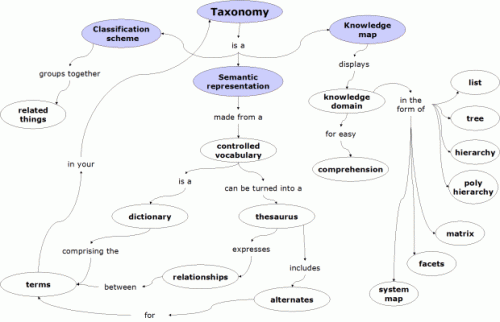
Graphically, the most common image of constructivist pedagogy is the concept map. I think of the concept map to symbolically represent new ways of learning, because concept mapping embraces so many of the ideals of knowledge organization and constructivism. Concept maps, as they appear on the World Wide Web, are beautiful; they demonstrate the aesthetic link to science.

In younger classes, the activity of concept mapping is referred to as webbing. Concept maps, or webs, create holistic pictures of the knowledge that the children are building. They store and reveal facts in relation to the environment: they describe how systems work. Mapped facts, thus improved by showing their relation to other facts, are thought of as concepts.

The connections between the facts, or the connecting lines, have descriptive words in them to show the relationships between the facts. In a sense, concept mapping ideas, when fully utilized, can resemble language. Many well developed maps can actually be converted directly into sentences and paragraphs. For me, this is the most surprising aspect of concept mapping.

Thanks to Patrick, Defining Taxonomy, Green Chameleon

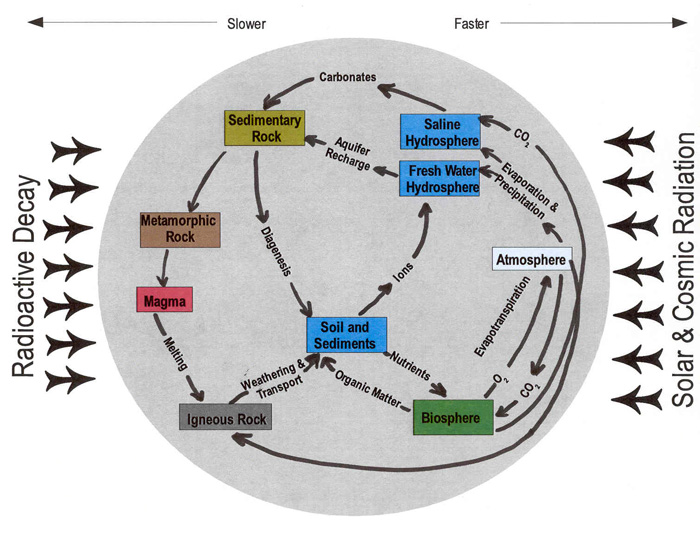
Building concept maps for earth science

They can be used to give a holistic view of any area of study, sometimes called a general systems theory. They can be used to show how areas of study interrelate into a view of all the Earth, everything on it, and possibly even space. A complete map is (at the moment) impossible to build; it would have to include the sum of all science. But, concept mapping technology can potentially demonstrate many aspects of our universe to children.

Thanks to Katy, Michelle, Howard, Martin, Sarah, Mark, Bob, and Suzanne


    Creating a concept Map

  • Create the concept map so that it embraces the whole area of study
  • Make it as generalized as possible so that the important, top-level components, as provided by the students or suggested by teacher, are likely to be correct
  • When attaching new ideas to the concept map, allow for alternative explanations, and even concepts, to be added in parallel as alternative learning to encourage generalization and extrapolation
  • As concepts are added, design experiments to test the component's validity within the map's structure as well as the validity of the newly modified map itself
  • Allow students, as a group, to move concepts around and modify them based on new perceptions
  • Allow students to modify and expand the concept map based on both knowledge gained from observation and experimentation as well as valid sources
  • Cyclic improvement: As students grow, their ability to model component concepts and critically examine them grows; the concept map becomes more valid both in accuracy and scope
  • If students are in agreement as a group about the concepts, hence the map, they can easily dispel scientific misconceptions

Use of concept maps to build correct knowledge

A major learning challenge facing middle school students is the modification of the often un-scientific views of natural phenomena they bring to school from their families and the community. Their misconceptions, however, are not a barrier to learning science; students may be wrong because some of the facts they believe may be wrong, but they are not so much wrong as intelligently wrong--assuming their efforts to understand are genuine (Ault from Shapiro, 21). The misconceptions can springboard inquiry into phenomena, and create enthusiasm for experimentation. Middle school students, especially the younger ones, will believe each other's views over the say-so of a teacher. (Stavy, Tirosh, 87) Therefore, if they can develop the correct conceptual understandings as a group, they will be far more likely to fully absorb accepted explanations of scientific phenomena.

The value of using inter-networked computers for concept mapping is in the sharing, and storing, the maps. Students in one location can work on a map; offer it through the web to another group, which in turn would improve it. Also, as students update their concept maps as they learn more, they can be assured of safe storage for their knowledge, they can return to it, improving it over the years.

A key characteristic of the concept map, then, is in fact cyclic. With each learning cycle, information is accessed and used. If flaws are found they are removed, cyclically improving knowledge by eliminating scientific misconceptions with granular effectiveness. As the improved information is returned, and new information is added, student groups will eventually get to the real science. Because they developed the knowledge themselves, with guidance from their teachers, they will believe it and transmit it to other students, their families, and local communities.

Technology to benefit Learning to Learn

Goals of project science include reflection, sharing, testing, searching, and cyclic improvement:

  • Reflecting on existing knowledge and observations
  • Developing concepts from new ideas
  • Discovering relationships between concepts
  • Creating experimentation to test concepts (and their interrelationships)
  • Locating and communicating with mentors for guidance
  • Sharing new information with learners working on similar projects

Existing technologies and sources are available for students who are building information:

  • Text editors for creating documents
  • Spread sheets for keeping test data and creating graphs
  • Servers to keep information safe and allow for easy access
  • WWW search engines to provide clues for inquiry topics, provide information to assist experimentation, and fortify knowledge with valid research material
  • Forums and mailing lists that can be used to initiate information finding, and also for locating like-minded investigators and possibly mentors
  • Scholarly on-line documents to be searched for potential mentors
  • Concept mapping and mind mapping software that may help in developing concept maps


Important considerations when using technology

Information technology is like a car in two respects. Both information technology and cars can take you places to enhance your awareness; hence the use of the analogy of the information super-highway to describe the Internet. Also in both, the underlying technologies are not obviously apparent as on, say, a bicycle.

To successfully use a car, you do not necessarily have to investigate the underlying technology that powers the car; you can easily drive a car without ever raising the hood (until the engine fails from lack of maintenance).

But, the sophisticated use of information technology is very different than the use of a car's technology. If you do not understand the underlying technology of the information systems that you use, their technology will tend to drive you.

Applications will lock you into their methodology of knowledge organization and, in so doing, limit your success in constructing knowledge with the inherit limitations of their underlying technology. Community knowledge construction, as with any physical community construction, can be limited by existing architectural limitations. The architecture of the technology, the underlying principles, hence the limits of the technology, can be purely arbitrary.

Fortunately, anyone using modern languages such as Java, Perl, PHP, or Ruby, can develop new knowledge construction paradigms limited only by their extent of his imagination.

The result of all this freedom is that the majority of information openly available on the web is on web sites built strictly using pubic-domain software. The most common paradigm for information sharing is a mixture of software called LAMP: Linux (operating system), Apache (web server), MySQL (database), and PHP (web site programming language). Endless tools, called frameworks, are available to assist in technology development; existing public domain software built with these frameworks can easily be customized.

Added to the list of available technology are the public domain software offerings:

  • Operating systems
  • Web servers
  • Data servers (also called databases)
  • Object oriented programming languages
  • Turn-key community software

Students are universally enthusiastic about the use of technology. Many are highly adept to learning programming and system control languages, just as they can easily learn new phonetic languages. As soon as students develop expertness with computer use, they should be given every opportunity to build their own community of knowledge construction systems.


Wednesday, September 06, 2006

Beyond the Discussion Thread

Text can be thought of as words created of letters, but they, by definition more than that, the word text derives from the concept of weaving. Text is push-thought. But, to become valid in society, ideas (push-thoughts) need to move into some kind of context.

"Textual knowledge is that relevant to understanding of grammatical aspects of the language"

"Contextual knowledge means the awareness of inter-sentential relationships and the cumulative impact of all preceding text"

Going beyond that, many define further steps ideas can take into their environments, usually referring to them as something like extra-contextual. Language moves from statement units into a context of surrounding statements, and finally into a social environment to gain real and relevant meaning.

"elements that exceed lexical definitions, sentential rules, and compositional principles" exist in "social structures, cultures, expectations, values, behaviors, and language use." Link

In constructively, the extra-contextual environment is thought of as situational. Situational learning goes a dimension beyond contextual learning. It describes the environment a student experiences as she heads out into the sea of discovery, having been released from the initial community of learning, which is usually made safe with scaffolding. She is truly at sea; her learnings lead to discoveries which in turn create many questions, confusion, frustration, and self-doubt. The process of mastery in new areas of learning is fraught with risk and difficulty.

Situational discovery provides ideas so new that no scaffolding can possibly support them. Situated learning is where significant contributions can evolve; where truly revolutionary ideas and solutions to perennial problems can be discovered and developed. Possibly, the ideal work group size for situated learning is two, to provide mutual support. More than two may result in a desire to turn back into safer areas of learning. And, a solo learner will have to weather the emotional stress of self-doubt unassisted. In project science, it is the responsibility of the teacher to help situated students create structures for inquiry, which may, or course, evolve into newly situated confusion. The teacher will have to develop a sense of humor about all this.

Teachers assist students in their project development by helping them analyze new questions, and mysteries, to help them better design inquiry paths as their situated learning reveals to them questions they never knew existed. In project science, the primary goal is building knowledge development skills first, then achieving significant understandings as contributions to community knowledge.

At a certain point, a discussion will ideally revert into individual efforts again because the supports provided by group discussion no longer help the creation of new ideas and significant change. Questions will arise as the result of attempting understanding; the process of inserting thoughts into the group context, hopefully, will raise questions which will lead to significant new discovery. As efforts become situated in the environment, where true impact can be experienced, relationships may develop with the information target audience, hopefully creating new potentials for generalized perception, action, and societal influence.

In the Information Society itself, as separate from human society, ideas spawn into the cytoplasm of contextual interaction. They become situated with each other: clustered into community by commonalities. So, where is the risk? I imagine it is in releasing into the Information Society cytoplasm thoughts whose ideas are so original that they can find no thoughts to link with. But, this seems highly unlikely; the power of the Internet is to link all of humanity. With six billion humans out there, there must be someone thinking the same things; the cytoplasm is safe.

When is a thought, or idea, best set free? Should it be released as an embryonic idea, or an idea that developed within the context of a discussion (the zone of personal development), or an idea that evolved as the result of risky situational discovery. Could it be that within the process of the empathic delivery of influential information, newly developed information becomes the basis of the initiation of a new comprehension, empathizing, and knowledge delivery. Knowledge building is the process of the creation of embryonic ideas.

The actual cumulative effect of the community may ultimately be to spawn embryonic ideas based on questions developed form successful previous knowledge building, an extension of the classical scientific corollary. Resolving political injustices, the activist task, is in effect the process of creating meaning that can be effectively used to construct society's knowledge tree.

The Information Society, now operating far beyond the fairness ideals of two-way communication envisioned by the Humanist engineers Lewis Mumford and Buckminster Fuller, can now allow activists using thought-linking to arrange their concerns into a matrix of ideas which are not criticisms but beneficial suggestions. This is an improvement of the traditional activist role of complainer. It is possible that a fully sophisticated knowledge structure can be analogized by anybody looking at a snowflake. This structure can be laid down on top of the topography of society, which happens to be the surface of the planet, to create a matrix of interactions that are wholly beneficial and based on trust: a resolution to the pain caused by the inequity of what is called free trade.

The features that make humans beneficial (very likely the ideas developed innocently as children become situated in society), can be accessed easily through linking. Contextual Ideas neighboring to originally and locally developed ideas are already familiar because linked ideas have commonalities. When ideas are linked, thoughts can evolve conceptually based on incremental differences. As people traverse through a (or the) matrix of linked ideas, no great leaps are necessary. People accessing information already have mastery of much of the neighboring information, neighboring ideas can be easily mastered allowing easy travel onto other sightly distant neighboring ideas.

Possibly a strong validating feature in contextual linking, is consensual linking. As in a web based friendship, possibly from a real-life friendship, is the idea of permission in friendship. On Care2 (http://www.care2.com), you ask permission from another member to be his friend. It is rare that friendships are rejected, but the process requires consent. In real life, people seeing things in each other that they like simultaneously mutually bond. Delays within Internet communication systems, as well as difficulty in perceiving emotions through the Internet, prevent instantaneous bonding. But, once online friends are introduced in real life, that bonding often occurs.

Linking takes contextual statements from paragraphs, and bigger documents; and creates from many linked statements, the thought basis of highly synthesized documents. Servers are used to link contextual text, consequentially; but, only the human can reflect on text within context, giving it meaningful linking attributes.

As part of the service process of idea linking (something has to do the linking, it might as well be a public domain free system) matched linking profiles would trigger messages seeing if mutual linking is possible. Mutually consensual linking will certainly reinforce the validity of ideas within common areas of comprehension. Opposing ideas, defined by mutually opposing linking profiles, will very likely never connect, though a daring linking server might try to interrelate opposing ideas in an attempt to seek a resolution between them. This may, instead, result in conflict. Still, within the area of idea comparison, and knowledge construction, idea differences never result in anything illegal. The worst type of Internet conflict is the flame-war, the online trading of insults: hardly something to worry about.

Societal knowledge thus built and tested in the activist context as well as the linking process, including consensual linking, would likely be unassailable by the lies of deliberate disruption and free of corruption--a significant improvement over the arbitrary law-making and enforcement process under which we now labor.

It is only in the journey into unexplored areas that comprehension and empathic understanding may be difficult. This may be because many problems have remained unresolved. The journey into discomfort, pain, and even death (the realm of the activist) is fractured and unsupported. The human mind becomes nearly unable to process successfully, yet activists go there anyway. The new model exists to assure the support of an expansive community in this emotionally dangerous area of situated societal discovery.

Wednesday, August 16, 2006

Why We Need Linux

In 1989, I recognized that there should be a global free network for all the people to use to communicate. I was a mechanic at the time, and I distinctly remember the moment; I was spitting out a mouthful of antifreeze while pulling a hose off of a corroded radiator.

I was envisioning for myself the Internet; soon after that I pursed a career in computer communication. Today all of you benefit from the work of the Internet engineers.

But, unfortunately, the computer you use right now is licensed to the most controlling and wealthiest organization in the world: Microsoft.

It may be difficult to conceive of how a computer company can be so controlling and dangerous unless you investigate the entire history of humanity and how information technology has been corrupted to implement control and cruelty from the very beginnings of humanity.

The first machine was built from human parts: it was the Egyptian empire's slavery structure created to build edifices to its elite, so the elite could live forever in the after world. They had no machines as we know them today: they rolled blocks on logs; they killed most of their slaves and workers with the effects of rock mining through silicosis poisoning.

This is a theme through humanity to the present-day blue collar worker. Even unions support the concept that the worker is part of the machine, to be used and broken for support of a system owned wholly by the elite. This concept is called human capital.

The military works in a similar way, molding youth to become cannon fodder. At the center of it all, is the same control structure the they Egyptians built. Here in the US, direct descendants of the Egyptian edifice builders provide loyal support for the President and the war in Iraq; they are the Freemasons and the Shriners.

Knowledge is treated exactly the same as real estate property. The globalist information protection organization, WIPO, defines this for us -- World Information Property Organization. They are committed to the acquisition of all technical knowledge and art into corporate portfolios, just as SONY owns the freedom lyrics of John Lennon.

Free and open information, such as GNU or open source, is referred to as being part of the public domain. The public domain originates with the wild lands that were available to everybody. As an example the elite European families created estates by illegally absorbing the public lands to implement a form of slavery called serfdom.

Colonialists in the America's did much the same, genociding the native tribes directly through murder, isolation, forced migration and disease. All the while, the colonialist information technology, as it was, allowed the expansionists to appear civilized and social through lies as they stole all the free land. Today, the acquisition of protected land through the process of eminent domain, allows municipal governments to destroy the last forests, installing the sub-divisions of suburban sprawl filled with the worst possible houses.

At the center of information control today is Microsoft; we are all paying homage and cash to the modern control structure at this very moment while we attempt to undo the authoritarian control that is destroying our planet.

What is the solution ?? Linux is.

Linux is a free operating system designed purely democratically and made available for the public. It is linked to the GNU philosophy and support organization, which is religiously opposed to the criminal control of computers and communication by the same people who are reducing our planet to the needs of corporate stockholders. While resolving the issues of information technology, the free software movement provides ideas which can be extended to all technology, especially in the areas of energy and transportation. A further extension of the philosophy can help us understand our unnecessary dependence on physical property.

The free and open software philosophies are not communist in any way, they supports free enterprise through sharing, through the high synergy and democratic developers of the public domain.

The very opposite of this high synergy, which is the meaningful distribution of resources, is capitalism. Capital is not money, as
much as capitalists want you think it is. Capital purely describes the inefficient centralization of resources, the piling of all wealth in central locations, all of which are controlled by the elite of each nation's dominant cultures.

The term derives from caput in Latin, meaning head. The practice of it derives from the highly damaging slavery-based Roman empire. I barely need to remind you how horrific their animal blood sports were.

Microsoft directly inherits the Roman Empire's diffuse communication and centralization network, as well as its mantel of acquisition and control.

Response from Rex Ballard
(rex.ballard@gmail.com)

Note: My original text is in italics

In 1989, I recognized that there should be a global free network for all the people to use to communicate. I was a mechanic at the time, and I distinctly remember the moment; I was spitting out a mouthful of antifreeze while pulling a hose off of a corroded radiator.

That is a bit funny. I can just imagine the 'aha' moment as you are dousing yourself with radiator fluid.

You certainly weren't the first to have that epiphany. The concept of a 'Free information exchange' actually goes back to a group of students at MIT back in the early 1970s. And even before that, the Civilian National Aeronautics and Space Administration had created an environment where technology was freely and agressively shared. In fact, from 1963 to 1969, when we were racing to reach the moon, there were amazing breakthroughs in technology that were shared freely among
the scientific community. Ironically, there were also military projects which were embedded in this technology that were top secret. The flood of freely available information diverted attention from the development of ICBMs, spy satellites, and other technologies often considered 'UFOs' at the time. In 1972, students at MIT wrote 'The hacker's ethic'. They advocated
the publication of technology in source code format. Keep in mind that the patent office had ruled that algorythms could not be patented. They had also ruled that since software programs were merely an expression of an algorythm, software could not be patented. Software couldn't be protected in binary form, nor could it be patented, until 1976.

In 1976, the laws were changed in the united states, taking effect in 1977. The interesting thing is that this was the year that Microsoft used it's "License' to push OEM MITS to purcase 'per processor' licenses. This concept, though expressed in many different ways as a result of court rulings, has been the backbone of Microsoft's financial structure.

I was envisioning for myself the Internet; soon after that I pursed a career in computer communication. Today all of you benefit from the work of the Internet engineers.

My brother had a similar epiphany. He was busting tires and in a moment of clarity during mindless activity, decided to put away his monkey wrench and work on computers. He's retired now, but he eventually wrote some computer programs for the army during Desert Storm, and later got into customer service, providing telephone support.

But, unfortunately, the computer you use right now is licensed to the most controlling and wealthiest organization in the world: Microsoft.


Not by accident. Bill Gates had the vision of 'being to business what heroin is to drug addicts' as far back as the late 1970s. By 1979, several computers were powered by Microsoft BASIC in ROM, including the Commodore PET, the TRS-80, and eventually the IBM PC.

It may be difficult to conceive of how a computer company can be so controlling and dangerous unless you investigate the entire history of humanity and how information technology has been corrupted to implement control and cruelty from the very beginnings of humanity. The first machine was built from human parts: it was the Egyptian empire's slavery structure created to build edifices to its elite, so the elite could live forever in the after world. They had no machines as we know them today: they rolled blocks on logs; they killed most of their slaves and workers with the effects of rock mining through silicosis poisoning.

Microsoft and Apple both established the concept of technology based projects as the domain of the elite. The Open Source community, going back as far as the MIT 'hackers', was more focused on a more 'democratic' use of technology.

On the other hand, technology was very carefully guarded, and it's quite likely that those who were taught the 'sacred sciences', including electricity, chemistry, biology, and architecture, were probably enlisted into lifetime priesthood positions.

The irony is that today, corporations have taken the opposite view, often cutting staffs of highly skilled workers, encouraging them to spread technologies to other companies, as they hired sklled workers from other companies - again adding breath and depth to the technology base of each company.

The byproduct was that more and more technology HAD to be kept in Open Source, simply because there was too much risk in using proprietary technology which had been learned at one company and used at another company.

In general your post is very interesting and really does hit the nail on the head.

Response from Homer (s... @uce.gov)

Note: My original text is in italics

It may be difficult to conceive of how a computer company can be so
controlling and dangerous unless you investigate the entire history of humanity and how information technology has been corrupted to
implement control and cruelty from the very beginnings of humanity.

It's called Corporatism, and through global cooperation with other corporate entities, ultimately leads to Corporate Imperialism. Globalism is the most obvious current manifestation.
Free and open information, such as GNU or open source, is referred to as being part of the public domain. The public domain originates with the wild lands that were available to everybody.

This is Marxism, the purest form of Socialism.

At the center of information control today is Microsoft; we are all paying homage and cash to the modern control structure at this very moment while we attempt to undo the authoritarian control that is destroying our planet.


Microsoft holds the balance of power, not only because of its immense wealth, but also because of the prevalence of it's products in society. They have great influence, and use that influence to further their ideals, which are, by and large, Corporatist.
What is the solution ?? Linux is.

Information Technology is the key area in which Corporatism spreads its influence, and as such, breaking that chain with the introduction of key I.T. frameworks, software, licences, protocols, and policies, based on open standards, may hopefully weaken that influence; preferably destroying it.

I.T. is only one front of the battle however; the influence of Corporatism affects all Industrial Society, and by association, all
society. For as long as there exists the ideology of financial profit, society will be driven by greed, corruption and exploitation.

Linux is a free operating system designed purely democratically and made available for the public. It is linked to the GNU philosophy and support organization, which is religiously opposed to the criminal control of computers and communication by the same people who are reducing our planet to the needs of corporate stockholders.

While resolving the issues of information technology, the free software movement provides ideas which can be extended to all technology, especially in the areas of energy and transportation. A further extension of the philosophy can help us understand our unnecessary dependence on physical property.

I can see that you and I are going to get on *very* well indeed.

The free and open software philosophies are not communist in any way, they supports free enterprise through sharing, through the high synergy and democratic developers of the public domain.


The fundamental principles are very close to Marxism though, and I have no problem at all with that. We are all born into this Global Corporatist society; how we choose to live in it, is a matter of preference. I chose to not oppose it for a long time, due to apathy and ignorance, and indeed profited financially by it. I have Microsoft (and the Bush administration) to thank for drawing my attention to the extent of corruption in our modern society, and I will endeavour to use the tainted resources it has given me, to oppose it.
--
K.
/* values of ß will give rise to dom! */

Why we need Linux, Part 2

I am really glad this got so many responses, albeit some from many who couldn't resist pointing to the possibility of antifreeze poisoning; this is why I don't work in the computer field anymore: too many who don't use the intelligence they were born with.

Please note that the thing that is new here, is that the information technology issue goes so far back in history.

Absolutely nothing has changed, because the exact same types of people are doing the exact same things in the exact same way. Creating a machine out of people with a control structure was the only genius of the early elite. They, like Microsoft, made no substantial technical contributions. We democratic developers do that. The authoritarian technology system that Microsoft now leads simply co-opts the technology, meddling with it until it fails, forcing them to steal more technology.

I find it odd to hear linux users protecting Microsoft, criticizing me for calling MS evil.

Thank you, Homer and Rex Ballard for your support. As I said, you cannot go back far enough, it's like the plot to Stargate.

You would probably agree that every major innovation has been accompanied by a stock swindle, the Internet being the most recent and most painful for many of us.

The swindles precede stocks, though. Watt, inventor of the steam engine got robbed through the patent courts by the mine owners that used it to pump water from their shafts; he barely collected any money at all. The inventor of textile's flying shuttle likewise got robbed despite his patents. Both these inventions were revolutionary and affect us directly today.

While working on Wall Street, I always wondered what manual the creeps all around me were working from. As it turns out, they inherited human systems control information developed during the beginnings of civilization probably from their families. If I had been introduced to these concepts as a child, during freer times, I would have laughed.