I am finding that there are many collaborative projects springing up. This is not new, collaboration has been a staple of modern art since the 1930s. What is new is the support coming from the institutional and administrative sides.
I recently had an eerie experience when I visited some friends of mine form the 80s. Back in the 80s, I had befriended many people who I felt were cast of from society. I had lost touch with them during the 90s, as I was a financial technologist, but I have recently made contact with a few of them.
One of them, a man I had know for a long time (who is now in a psychiatric program) was helping me get a new car battery. While he and I, and another old acquaintance, were on our way to get the battery in his car, we picked up a hitchhiker, another old friend. Suddenly when we started again, the plans changed (possibly a typical behavior of crazy people); I wound up in a different place, miles from where I had started.
Effectively, my choices had been removed, and I felt like I was being railroaded--even kidnapped. When I complained, I was criticized for having "bad vibes" and for ruining the friendly atmosphere (there were a total of four of us in the car, all old acquaintances).
At that point, somebody suggested that everybody put their heads together to find a solution so I can get a car battery: developing community knowledge.
When I told them I wanted to go back to where I had started because I knew I was better off getting a battery on my own, I was accused of rejecting the community support that they offered. The idea that all my basic rights had been violated in every way did not occur to all these people; I was the bad person for not wanting to work with the newly offered community knowledge; this was the group consensus.
Herein lies the danger of community knowledge construction; there is no question in my mind, that at least some of these people (all in mental programs) have been exposed to social knowledge construction ideas, probably by one or more of their therapists.
Community knowledge is meant as an empowering strategy, yet, in this case, it was converted, into the removal of all my personal rights: a condemnation of my actions to be independent, and for not supporting that local community.
Granted, all these people have mental problems, but the experience was still chilling to me on a fundamental level. It was almost like science fiction; a future society gone completely wrong as a result of all the best intentions. Here, the best intentions of community construction were converted into into the worst nightmare possible: fascism.
In social intelligence, the idea is to accumulate individual ideas into community of knowledge to help create concepts beyond the sum of the individual contributions; community knowledge is also shared among the community, making the whole community more effective. But, as we well know, groups of people can go bad in a hurry, as happens in biased and hatred situations.
I am thinking that the solution to this obvious quandary is in the cyclic development of ideas , as I have often mentioned in my writing when talking about science projects and concept building for middle school students. We humans work in groups to develop projects (and to combat loneliness), and then return to individual work to access internal inspiration: self-actualization.
In the cyclic scenario, there will be times when controlling people will try to disrupt the cycle to insert themselves as the dominant individual creating the type of groups sociologists, such as Aaron Beck, warn about as being the most dangerous component of humanity. Here, there community itself becomes the disrupting force, removing individual rights, pushing our humanity back into darkness from which we continually try to emerge.

With Ed Snowden's NSA-leaking, the need for L4 as a modular, transparent operating system becomes even more obvious, and Linux with its monolithic/oligarchic architecture (and culture) becomes increasingly dangerous, and Windows might capitulate to the ultra-quick buck. Link below-right leads to my "crucible" on oddmuse where I do my "status updates."
About
The goal of the Linux-Society (LS, dating back to the mid-90s as a professional club and tech-mentoring group) has been a purely-democratic Information Society; many of the articles are sociological in nature. The LS was merged with Perl/Unix of NY to form multi-layered group that included advocacy, project-oriented learning by talented high school students: textbook constructivism. Linux has severe limitations such that it is useless for any computer that will, say, print or scan. It is primarily used for webservers and embedded devices such as the Android. (Google is high-invested in it).
Technology is problematic. During the heyday of technology (1990s), it seemed it had the democratic direction Lewis Mumford said it should have in his seminal Technics and Civilization.
Today, we are effectively stuck with Windows as Linux is poor on the desktop and has cultured a maladaptive following. Apple is prohibitive, and all other operating systems lack drivers, including Google's Android, an offshoot of linux.
In the late 90s there was hope for new kernels such as LibOS and ExoOS that would bare their hardware to programs, some of which would be virtual machines such as Java uses. Another important player was the L4 system that is a minor relation to the code underlying the Apple's systems. It was highly scientific but fell into the wrong hangs, apparently, and has suffered from having no progress on the desktop. There is a version, "SE" that is apparently running in many cell phones as specialized telecom chips, but is proprietary. SE's closed nature was only recently revealed, which is important because it is apparently built from publicly-owned code as it is not a "clean room" design it may violate public domain protections, and most certainly violates the widely-accepted social contract.
Recent attempts to enjoin into L4 development as an advocate for "the people" have been as frustrating (and demeaning) as previous attempts with the usual attacks to self-esteem by maladaptive "hacks" being reinforced by "leadership" (now mostly university professors).
In short, this leaves us with Windows, which is quite a reversal if you have read earlier posts here. But, upon Windows, we have free and open software development systems in the forms of GTK+ (the windows usually used on Linux) and the Minimal GNU Windows (MinGW and MSYS) systems. It is very likely this direction that development should go (that is, on Windows) such that s/w can then be ported to a currently-valid microkernel system that includes a driver system that can be adapted by hardware developers to reuse of their windows and apple drivers.
From a brief survey of L4, it appears that the last clean copy was the DROPS system of the early 2010s, was a German effort that used the Unix-like "OS kit" from an American University.
If we are going to be stuck on Windows, then it seems that a high level approach to free and open systems integration, such as creating fully transparent mouse communication between apps so that they can seamlessly work together as a single desktop (rather than deliberately conflicting). This would be very helpful for GIMP and Inkscape, both leading graphics programs that are strong in the special ways, but suffer from an inability to easily interrelate.
Another important issue is the nature, if you can call it that, of the "geek" or "hack." Technology is formed democratically but "harvested" authoritarian-ly --if I can coin a term that Mumford might use. Authority is plutarchy: a combination of aristocracy and oligarchy that is kept alive after all these millennia by using, or maligning, the information society as a part of the civilizing (or law-giving) process that embraces the dialectic as its method. Democratic restoration, that is to put humanity back on an evolutionary (and not de-evolutionary) track, I think, will require the exclusion of the "geek" from decision-making. As is, the free/open s/w culture attempts to give leadership to those who write the most lines of code --irrespective of their comprehension of the real world or relationship with normal users. We need normal people to somehow organize around common sense (rather than oligarchic rationalism) to bring to life useful and cohesive software and communications systems.
Interestingly, the most popular page on this site is about Carl Rogers' humanistic psychology, and has nothing to do with technology.
Technology is problematic. During the heyday of technology (1990s), it seemed it had the democratic direction Lewis Mumford said it should have in his seminal Technics and Civilization.
Today, we are effectively stuck with Windows as Linux is poor on the desktop and has cultured a maladaptive following. Apple is prohibitive, and all other operating systems lack drivers, including Google's Android, an offshoot of linux.
In the late 90s there was hope for new kernels such as LibOS and ExoOS that would bare their hardware to programs, some of which would be virtual machines such as Java uses. Another important player was the L4 system that is a minor relation to the code underlying the Apple's systems. It was highly scientific but fell into the wrong hangs, apparently, and has suffered from having no progress on the desktop. There is a version, "SE" that is apparently running in many cell phones as specialized telecom chips, but is proprietary. SE's closed nature was only recently revealed, which is important because it is apparently built from publicly-owned code as it is not a "clean room" design it may violate public domain protections, and most certainly violates the widely-accepted social contract.
Recent attempts to enjoin into L4 development as an advocate for "the people" have been as frustrating (and demeaning) as previous attempts with the usual attacks to self-esteem by maladaptive "hacks" being reinforced by "leadership" (now mostly university professors).
In short, this leaves us with Windows, which is quite a reversal if you have read earlier posts here. But, upon Windows, we have free and open software development systems in the forms of GTK+ (the windows usually used on Linux) and the Minimal GNU Windows (MinGW and MSYS) systems. It is very likely this direction that development should go (that is, on Windows) such that s/w can then be ported to a currently-valid microkernel system that includes a driver system that can be adapted by hardware developers to reuse of their windows and apple drivers.
From a brief survey of L4, it appears that the last clean copy was the DROPS system of the early 2010s, was a German effort that used the Unix-like "OS kit" from an American University.
If we are going to be stuck on Windows, then it seems that a high level approach to free and open systems integration, such as creating fully transparent mouse communication between apps so that they can seamlessly work together as a single desktop (rather than deliberately conflicting). This would be very helpful for GIMP and Inkscape, both leading graphics programs that are strong in the special ways, but suffer from an inability to easily interrelate.
Another important issue is the nature, if you can call it that, of the "geek" or "hack." Technology is formed democratically but "harvested" authoritarian-ly --if I can coin a term that Mumford might use. Authority is plutarchy: a combination of aristocracy and oligarchy that is kept alive after all these millennia by using, or maligning, the information society as a part of the civilizing (or law-giving) process that embraces the dialectic as its method. Democratic restoration, that is to put humanity back on an evolutionary (and not de-evolutionary) track, I think, will require the exclusion of the "geek" from decision-making. As is, the free/open s/w culture attempts to give leadership to those who write the most lines of code --irrespective of their comprehension of the real world or relationship with normal users. We need normal people to somehow organize around common sense (rather than oligarchic rationalism) to bring to life useful and cohesive software and communications systems.
Interestingly, the most popular page on this site is about Carl Rogers' humanistic psychology, and has nothing to do with technology.
Friday, October 06, 2006


Wednesday, October 04, 2006
Thought Linking and Resulting Language Technologies
(Part 1) More than ever, public domain software is needed
Linking will resist natural writing, it may very likely create language that is very mechanical. It seems probable to me that the mechanics of language will be described as algorithms in the very near future; machines will develop speech directly form concepts, in any language. While on one level that would seem to be a tremendous aid to international communication, but then we face democracy issues--who will be able to use this empowering technology? And, who will be left out of the process? Furthermore, multi-national corporations will use this (and every other) technology to shrink their staff size, making themselves more effective (and therefore profitable) while shrinking benefits to the average person from the economic system: neo-economics.
Language and linking technology are coming anyway, either by contract to corporations, or through the public domain. Since the goal of the Information Society is to seek democracy, linking and subsequent language technologies have to be created democratically in the public domain to assure that every person has access to these new tools. The alternative is unthinkable, pure control over language by corporate consortia exercising corporate governance (what they call corporate citizenship), resulting pure resource exploitation without regard for humanity or humane issues.
As corporations shrink in size and their powers expand, they eliminate the weak staff members. By stripping away all that is human and emotional, they increasingly concentrate a condition described as "pure intelligence" by Goleman in his book Emotional Intelligence. This describes pure objectivism with no emotional aspect as a mental disorder resulting in purely sociopathic behavior on the scale of genius.
Obviously, there can be no free enterprise competition when corporate consortia reach the final levels of technical and political control. Corporations have successfully dominated nearly every government they have encountered, Microsoft successfully preventing anti-trust prosecution, making itself the dominating control center of control itself. What is needed is vigorous resistance to the centralized control of information. So far, the way to do this has been to encourage the democratic public domain to develop truly free software. Now, under increasing pressure form corporate consortia, encouragement will have to give way to actual empowering.
Publicly developed technology is supported by the financial numbers: 90% of the cost of development is in the overhead, most of it being absorbed by marketing and sales staff. Free software has been developed for free, yet I now believe that grants should be provided to the scientists who will most likely continue to develop and promote free software.
In other words, society through the government can provide democratically available software for only a small percentage of the cost to corporations for proprietary software. The alternative is the continued support for the wholly illegal Microsoft monopoly, along with continued suffering resulting from damage to the computing industry by the Microsoft. Examples of technologies damaged by Microsoft's control over computer technology include the computer modeling of diseases: the obvious future of medicine. Microsoft, as an authoritarian entity, can only annex technology, they cannot create effective technology of their own. Since they, along with the globalist market, have left a waste land of commercial technical development, they can now only block public domain development. Furthermore, Microsoft's founder, Bill Gates, has inserted himself as a dominant force in the in the policy making of AIDS research: will he allow Linux based supercomputing to cure the disease? Judging from his previous behaviors, that is highly unlikely.
Linking will resist natural writing, it may very likely create language that is very mechanical. It seems probable to me that the mechanics of language will be described as algorithms in the very near future; machines will develop speech directly form concepts, in any language. While on one level that would seem to be a tremendous aid to international communication, but then we face democracy issues--who will be able to use this empowering technology? And, who will be left out of the process? Furthermore, multi-national corporations will use this (and every other) technology to shrink their staff size, making themselves more effective (and therefore profitable) while shrinking benefits to the average person from the economic system: neo-economics.
Language and linking technology are coming anyway, either by contract to corporations, or through the public domain. Since the goal of the Information Society is to seek democracy, linking and subsequent language technologies have to be created democratically in the public domain to assure that every person has access to these new tools. The alternative is unthinkable, pure control over language by corporate consortia exercising corporate governance (what they call corporate citizenship), resulting pure resource exploitation without regard for humanity or humane issues.
As corporations shrink in size and their powers expand, they eliminate the weak staff members. By stripping away all that is human and emotional, they increasingly concentrate a condition described as "pure intelligence" by Goleman in his book Emotional Intelligence. This describes pure objectivism with no emotional aspect as a mental disorder resulting in purely sociopathic behavior on the scale of genius.
Obviously, there can be no free enterprise competition when corporate consortia reach the final levels of technical and political control. Corporations have successfully dominated nearly every government they have encountered, Microsoft successfully preventing anti-trust prosecution, making itself the dominating control center of control itself. What is needed is vigorous resistance to the centralized control of information. So far, the way to do this has been to encourage the democratic public domain to develop truly free software. Now, under increasing pressure form corporate consortia, encouragement will have to give way to actual empowering.
Publicly developed technology is supported by the financial numbers: 90% of the cost of development is in the overhead, most of it being absorbed by marketing and sales staff. Free software has been developed for free, yet I now believe that grants should be provided to the scientists who will most likely continue to develop and promote free software.
In other words, society through the government can provide democratically available software for only a small percentage of the cost to corporations for proprietary software. The alternative is the continued support for the wholly illegal Microsoft monopoly, along with continued suffering resulting from damage to the computing industry by the Microsoft. Examples of technologies damaged by Microsoft's control over computer technology include the computer modeling of diseases: the obvious future of medicine. Microsoft, as an authoritarian entity, can only annex technology, they cannot create effective technology of their own. Since they, along with the globalist market, have left a waste land of commercial technical development, they can now only block public domain development. Furthermore, Microsoft's founder, Bill Gates, has inserted himself as a dominant force in the in the policy making of AIDS research: will he allow Linux based supercomputing to cure the disease? Judging from his previous behaviors, that is highly unlikely.
Saturday, September 16, 2006
Learning to Learn the "New Way"
From: Learning to Learn
Webbing and the Concept Map
Graphically, the most common image of constructivist pedagogy is the concept map. I think of the concept map to symbolically represent new ways of learning, because concept mapping embraces so many of the ideals of knowledge organization and constructivism. Concept maps, as they appear on the World Wide Web, are beautiful; they demonstrate the aesthetic link to science.
In younger classes, the activity of concept mapping is referred to as webbing. Concept maps, or webs, create holistic pictures of the knowledge that the children are building. They store and reveal facts in relation to the environment: they describe how systems work. Mapped facts, thus improved by showing their relation to other facts, are thought of as concepts.
The connections between the facts, or the connecting lines, have descriptive words in them to show the relationships between the facts. In a sense, concept mapping ideas, when fully utilized, can resemble language. Many well developed maps can actually be converted directly into sentences and paragraphs. For me, this is the most surprising aspect of concept mapping.
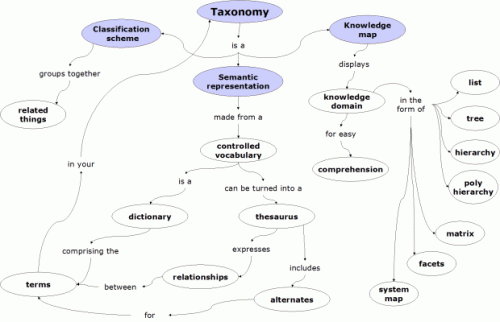
Thanks to Patrick, Defining Taxonomy, Green Chameleon
Building concept maps for earth science
They can be used to give a holistic view of any area of study, sometimes called a general systems theory. They can be used to show how areas of study interrelate into a view of all the Earth, everything on it, and possibly even space. A complete map is (at the moment) impossible to build; it would have to include the sum of all science. But, concept mapping technology can potentially demonstrate many aspects of our universe to children.
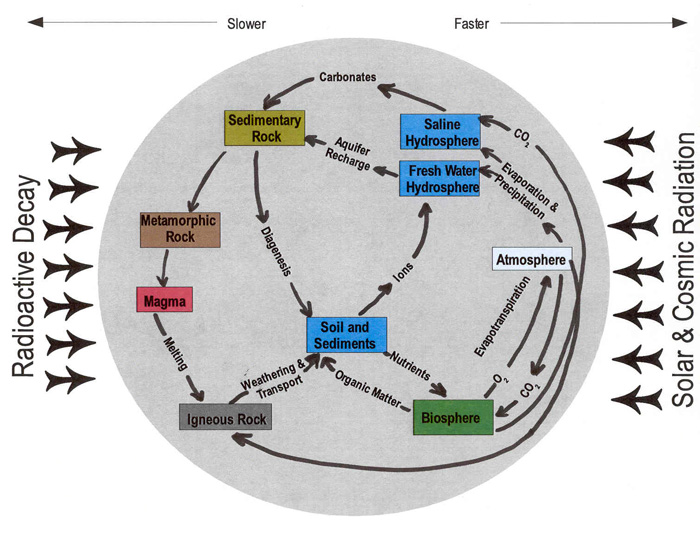
Thanks to Katy, Michelle, Howard, Martin, Sarah, Mark, Bob, and Suzanne
Creating a concept Map
- Create the concept map so that it embraces the whole area of study
- Make it as generalized as possible so that the important, top-level components, as provided by the students or suggested by teacher, are likely to be correct
- When attaching new ideas to the concept map, allow for alternative explanations, and even concepts, to be added in parallel as alternative learning to encourage generalization and extrapolation
- As concepts are added, design experiments to test the component's validity within the map's structure as well as the validity of the newly modified map itself
- Allow students, as a group, to move concepts around and modify them based on new perceptions
- Allow students to modify and expand the concept map based on both knowledge gained from observation and experimentation as well as valid sources
- Cyclic improvement: As students grow, their ability to model component concepts and critically examine them grows; the concept map becomes more valid both in accuracy and scope
- If students are in agreement as a group about the concepts, hence the map, they can easily dispel scientific misconceptions
Use of concept maps to build correct knowledge
A major learning challenge facing middle school students is the modification of the often un-scientific views of natural phenomena they bring to school from their families and the community. Their misconceptions, however, are not a barrier to learning science; students may be wrong because some of the facts they believe may be wrong, but they are not so much wrong as intelligently wrong--assuming their efforts to understand are genuine (Ault from Shapiro, 21). The misconceptions can springboard inquiry into phenomena, and create enthusiasm for experimentation. Middle school students, especially the younger ones, will believe each other's views over the say-so of a teacher. (Stavy, Tirosh, 87) Therefore, if they can develop the correct conceptual understandings as a group, they will be far more likely to fully absorb accepted explanations of scientific phenomena.
The value of using inter-networked computers for concept mapping is in the sharing, and storing, the maps. Students in one location can work on a map; offer it through the web to another group, which in turn would improve it. Also, as students update their concept maps as they learn more, they can be assured of safe storage for their knowledge, they can return to it, improving it over the years.
A key characteristic of the concept map, then, is in fact cyclic. With each learning cycle, information is accessed and used. If flaws are found they are removed, cyclically improving knowledge by eliminating scientific misconceptions with granular effectiveness. As the improved information is returned, and new information is added, student groups will eventually get to the real science. Because they developed the knowledge themselves, with guidance from their teachers, they will believe it and transmit it to other students, their families, and local communities.
Technology to benefit Learning to Learn
Goals of project science include reflection, sharing, testing, searching, and cyclic improvement:
- Reflecting on existing knowledge and observations
- Developing concepts from new ideas
- Discovering relationships between concepts
- Creating experimentation to test concepts (and their interrelationships)
- Locating and communicating with mentors for guidance
- Sharing new information with learners working on similar projects
Existing technologies and sources are available for students who are building information:
- Text editors for creating documents
- Spread sheets for keeping test data and creating graphs
- Servers to keep information safe and allow for easy access
- WWW search engines to provide clues for inquiry topics, provide information to assist experimentation, and fortify knowledge with valid research material
- Forums and mailing lists that can be used to initiate information finding, and also for locating like-minded investigators and possibly mentors
- Scholarly on-line documents to be searched for potential mentors
- Concept mapping and mind mapping software that may help in developing concept maps
Important considerations when using technology
Information technology is like a car in two respects. Both information technology and cars can take you places to enhance your awareness; hence the use of the analogy of the information super-highway to describe the Internet. Also in both, the underlying technologies are not obviously apparent as on, say, a bicycle.
To successfully use a car, you do not necessarily have to investigate the underlying technology that powers the car; you can easily drive a car without ever raising the hood (until the engine fails from lack of maintenance).
But, the sophisticated use of information technology is very different than the use of a car's technology. If you do not understand the underlying technology of the information systems that you use, their technology will tend to drive you.
Applications will lock you into their methodology of knowledge organization and, in so doing, limit your success in constructing knowledge with the inherit limitations of their underlying technology. Community knowledge construction, as with any physical community construction, can be limited by existing architectural limitations. The architecture of the technology, the underlying principles, hence the limits of the technology, can be purely arbitrary.
Fortunately, anyone using modern languages such as Java, Perl, PHP, or Ruby, can develop new knowledge construction paradigms limited only by their extent of his imagination.
The result of all this freedom is that the majority of information openly available on the web is on web sites built strictly using pubic-domain software. The most common paradigm for information sharing is a mixture of software called LAMP: Linux (operating system), Apache (web server), MySQL (database), and PHP (web site programming language). Endless tools, called frameworks, are available to assist in technology development; existing public domain software built with these frameworks can easily be customized.
Added to the list of available technology are the public domain software offerings:
- Operating systems
- Web servers
- Data servers (also called databases)
- Object oriented programming languages
- Turn-key community software
Students are universally enthusiastic about the use of technology. Many are highly adept to learning programming and system control languages, just as they can easily learn new phonetic languages. As soon as students develop expertness with computer use, they should be given every opportunity to build their own community of knowledge construction systems.
Wednesday, September 06, 2006
Beyond the Discussion Thread
Text can be thought of as words created of letters, but they, by definition more than that, the word text derives from the concept of weaving. Text is push-thought. But, to become valid in society, ideas (push-thoughts) need to move into some kind of context.
"Textual knowledge is that relevant to understanding of grammatical aspects of the language"
"Contextual knowledge means the awareness of inter-sentential relationships and the cumulative impact of all preceding text"
Going beyond that, many define further steps ideas can take into their environments, usually referring to them as something like extra-contextual. Language moves from statement units into a context of surrounding statements, and finally into a social environment to gain real and relevant meaning.
"elements that exceed lexical definitions, sentential rules, and compositional principles" exist in "social structures, cultures, expectations, values, behaviors, and language use." Link
In constructively, the extra-contextual environment is thought of as situational. Situational learning goes a dimension beyond contextual learning. It describes the environment a student experiences as she heads out into the sea of discovery, having been released from the initial community of learning, which is usually made safe with scaffolding. She is truly at sea; her learnings lead to discoveries which in turn create many questions, confusion, frustration, and self-doubt. The process of mastery in new areas of learning is fraught with risk and difficulty.
Situational discovery provides ideas so new that no scaffolding can possibly support them. Situated learning is where significant contributions can evolve; where truly revolutionary ideas and solutions to perennial problems can be discovered and developed. Possibly, the ideal work group size for situated learning is two, to provide mutual support. More than two may result in a desire to turn back into safer areas of learning. And, a solo learner will have to weather the emotional stress of self-doubt unassisted. In project science, it is the responsibility of the teacher to help situated students create structures for inquiry, which may, or course, evolve into newly situated confusion. The teacher will have to develop a sense of humor about all this.
Teachers assist students in their project development by helping them analyze new questions, and mysteries, to help them better design inquiry paths as their situated learning reveals to them questions they never knew existed. In project science, the primary goal is building knowledge development skills first, then achieving significant understandings as contributions to community knowledge.
At a certain point, a discussion will ideally revert into individual efforts again because the supports provided by group discussion no longer help the creation of new ideas and significant change. Questions will arise as the result of attempting understanding; the process of inserting thoughts into the group context, hopefully, will raise questions which will lead to significant new discovery. As efforts become situated in the environment, where true impact can be experienced, relationships may develop with the information target audience, hopefully creating new potentials for generalized perception, action, and societal influence.
In the Information Society itself, as separate from human society, ideas spawn into the cytoplasm of contextual interaction. They become situated with each other: clustered into community by commonalities. So, where is the risk? I imagine it is in releasing into the Information Society cytoplasm thoughts whose ideas are so original that they can find no thoughts to link with. But, this seems highly unlikely; the power of the Internet is to link all of humanity. With six billion humans out there, there must be someone thinking the same things; the cytoplasm is safe.
When is a thought, or idea, best set free? Should it be released as an embryonic idea, or an idea that developed within the context of a discussion (the zone of personal development), or an idea that evolved as the result of risky situational discovery. Could it be that within the process of the empathic delivery of influential information, newly developed information becomes the basis of the initiation of a new comprehension, empathizing, and knowledge delivery. Knowledge building is the process of the creation of embryonic ideas.
The actual cumulative effect of the community may ultimately be to spawn embryonic ideas based on questions developed form successful previous knowledge building, an extension of the classical scientific corollary. Resolving political injustices, the activist task, is in effect the process of creating meaning that can be effectively used to construct society's knowledge tree.
The Information Society, now operating far beyond the fairness ideals of two-way communication envisioned by the Humanist engineers Lewis Mumford and Buckminster Fuller, can now allow activists using thought-linking to arrange their concerns into a matrix of ideas which are not criticisms but beneficial suggestions. This is an improvement of the traditional activist role of complainer. It is possible that a fully sophisticated knowledge structure can be analogized by anybody looking at a snowflake. This structure can be laid down on top of the topography of society, which happens to be the surface of the planet, to create a matrix of interactions that are wholly beneficial and based on trust: a resolution to the pain caused by the inequity of what is called free trade.
The features that make humans beneficial (very likely the ideas developed innocently as children become situated in society), can be accessed easily through linking. Contextual Ideas neighboring to originally and locally developed ideas are already familiar because linked ideas have commonalities. When ideas are linked, thoughts can evolve conceptually based on incremental differences. As people traverse through a (or the) matrix of linked ideas, no great leaps are necessary. People accessing information already have mastery of much of the neighboring information, neighboring ideas can be easily mastered allowing easy travel onto other sightly distant neighboring ideas.
Possibly a strong validating feature in contextual linking, is consensual linking. As in a web based friendship, possibly from a real-life friendship, is the idea of permission in friendship. On Care2 (http://www.care2.com), you ask permission from another member to be his friend. It is rare that friendships are rejected, but the process requires consent. In real life, people seeing things in each other that they like simultaneously mutually bond. Delays within Internet communication systems, as well as difficulty in perceiving emotions through the Internet, prevent instantaneous bonding. But, once online friends are introduced in real life, that bonding often occurs.
Linking takes contextual statements from paragraphs, and bigger documents; and creates from many linked statements, the thought basis of highly synthesized documents. Servers are used to link contextual text, consequentially; but, only the human can reflect on text within context, giving it meaningful linking attributes.
As part of the service process of idea linking (something has to do the linking, it might as well be a public domain free system) matched linking profiles would trigger messages seeing if mutual linking is possible. Mutually consensual linking will certainly reinforce the validity of ideas within common areas of comprehension. Opposing ideas, defined by mutually opposing linking profiles, will very likely never connect, though a daring linking server might try to interrelate opposing ideas in an attempt to seek a resolution between them. This may, instead, result in conflict. Still, within the area of idea comparison, and knowledge construction, idea differences never result in anything illegal. The worst type of Internet conflict is the flame-war, the online trading of insults: hardly something to worry about.
Societal knowledge thus built and tested in the activist context as well as the linking process, including consensual linking, would likely be unassailable by the lies of deliberate disruption and free of corruption--a significant improvement over the arbitrary law-making and enforcement process under which we now labor.
It is only in the journey into unexplored areas that comprehension and empathic understanding may be difficult. This may be because many problems have remained unresolved. The journey into discomfort, pain, and even death (the realm of the activist) is fractured and unsupported. The human mind becomes nearly unable to process successfully, yet activists go there anyway. The new model exists to assure the support of an expansive community in this emotionally dangerous area of situated societal discovery.
"Textual knowledge is that relevant to understanding of grammatical aspects of the language"
"Contextual knowledge means the awareness of inter-sentential relationships and the cumulative impact of all preceding text"
Going beyond that, many define further steps ideas can take into their environments, usually referring to them as something like extra-contextual. Language moves from statement units into a context of surrounding statements, and finally into a social environment to gain real and relevant meaning.
"elements that exceed lexical definitions, sentential rules, and compositional principles" exist in "social structures, cultures, expectations, values, behaviors, and language use." Link
In constructively, the extra-contextual environment is thought of as situational. Situational learning goes a dimension beyond contextual learning. It describes the environment a student experiences as she heads out into the sea of discovery, having been released from the initial community of learning, which is usually made safe with scaffolding. She is truly at sea; her learnings lead to discoveries which in turn create many questions, confusion, frustration, and self-doubt. The process of mastery in new areas of learning is fraught with risk and difficulty.
Situational discovery provides ideas so new that no scaffolding can possibly support them. Situated learning is where significant contributions can evolve; where truly revolutionary ideas and solutions to perennial problems can be discovered and developed. Possibly, the ideal work group size for situated learning is two, to provide mutual support. More than two may result in a desire to turn back into safer areas of learning. And, a solo learner will have to weather the emotional stress of self-doubt unassisted. In project science, it is the responsibility of the teacher to help situated students create structures for inquiry, which may, or course, evolve into newly situated confusion. The teacher will have to develop a sense of humor about all this.
Teachers assist students in their project development by helping them analyze new questions, and mysteries, to help them better design inquiry paths as their situated learning reveals to them questions they never knew existed. In project science, the primary goal is building knowledge development skills first, then achieving significant understandings as contributions to community knowledge.
At a certain point, a discussion will ideally revert into individual efforts again because the supports provided by group discussion no longer help the creation of new ideas and significant change. Questions will arise as the result of attempting understanding; the process of inserting thoughts into the group context, hopefully, will raise questions which will lead to significant new discovery. As efforts become situated in the environment, where true impact can be experienced, relationships may develop with the information target audience, hopefully creating new potentials for generalized perception, action, and societal influence.
In the Information Society itself, as separate from human society, ideas spawn into the cytoplasm of contextual interaction. They become situated with each other: clustered into community by commonalities. So, where is the risk? I imagine it is in releasing into the Information Society cytoplasm thoughts whose ideas are so original that they can find no thoughts to link with. But, this seems highly unlikely; the power of the Internet is to link all of humanity. With six billion humans out there, there must be someone thinking the same things; the cytoplasm is safe.
When is a thought, or idea, best set free? Should it be released as an embryonic idea, or an idea that developed within the context of a discussion (the zone of personal development), or an idea that evolved as the result of risky situational discovery. Could it be that within the process of the empathic delivery of influential information, newly developed information becomes the basis of the initiation of a new comprehension, empathizing, and knowledge delivery. Knowledge building is the process of the creation of embryonic ideas.
The actual cumulative effect of the community may ultimately be to spawn embryonic ideas based on questions developed form successful previous knowledge building, an extension of the classical scientific corollary. Resolving political injustices, the activist task, is in effect the process of creating meaning that can be effectively used to construct society's knowledge tree.
The Information Society, now operating far beyond the fairness ideals of two-way communication envisioned by the Humanist engineers Lewis Mumford and Buckminster Fuller, can now allow activists using thought-linking to arrange their concerns into a matrix of ideas which are not criticisms but beneficial suggestions. This is an improvement of the traditional activist role of complainer. It is possible that a fully sophisticated knowledge structure can be analogized by anybody looking at a snowflake. This structure can be laid down on top of the topography of society, which happens to be the surface of the planet, to create a matrix of interactions that are wholly beneficial and based on trust: a resolution to the pain caused by the inequity of what is called free trade.
The features that make humans beneficial (very likely the ideas developed innocently as children become situated in society), can be accessed easily through linking. Contextual Ideas neighboring to originally and locally developed ideas are already familiar because linked ideas have commonalities. When ideas are linked, thoughts can evolve conceptually based on incremental differences. As people traverse through a (or the) matrix of linked ideas, no great leaps are necessary. People accessing information already have mastery of much of the neighboring information, neighboring ideas can be easily mastered allowing easy travel onto other sightly distant neighboring ideas.
Possibly a strong validating feature in contextual linking, is consensual linking. As in a web based friendship, possibly from a real-life friendship, is the idea of permission in friendship. On Care2 (http://www.care2.com), you ask permission from another member to be his friend. It is rare that friendships are rejected, but the process requires consent. In real life, people seeing things in each other that they like simultaneously mutually bond. Delays within Internet communication systems, as well as difficulty in perceiving emotions through the Internet, prevent instantaneous bonding. But, once online friends are introduced in real life, that bonding often occurs.
Linking takes contextual statements from paragraphs, and bigger documents; and creates from many linked statements, the thought basis of highly synthesized documents. Servers are used to link contextual text, consequentially; but, only the human can reflect on text within context, giving it meaningful linking attributes.
As part of the service process of idea linking (something has to do the linking, it might as well be a public domain free system) matched linking profiles would trigger messages seeing if mutual linking is possible. Mutually consensual linking will certainly reinforce the validity of ideas within common areas of comprehension. Opposing ideas, defined by mutually opposing linking profiles, will very likely never connect, though a daring linking server might try to interrelate opposing ideas in an attempt to seek a resolution between them. This may, instead, result in conflict. Still, within the area of idea comparison, and knowledge construction, idea differences never result in anything illegal. The worst type of Internet conflict is the flame-war, the online trading of insults: hardly something to worry about.
Societal knowledge thus built and tested in the activist context as well as the linking process, including consensual linking, would likely be unassailable by the lies of deliberate disruption and free of corruption--a significant improvement over the arbitrary law-making and enforcement process under which we now labor.
It is only in the journey into unexplored areas that comprehension and empathic understanding may be difficult. This may be because many problems have remained unresolved. The journey into discomfort, pain, and even death (the realm of the activist) is fractured and unsupported. The human mind becomes nearly unable to process successfully, yet activists go there anyway. The new model exists to assure the support of an expansive community in this emotionally dangerous area of situated societal discovery.
Wednesday, August 16, 2006
Why We Need Linux
In 1989, I recognized that there should be a global free network for all the people to use to communicate. I was a mechanic at the time, and I distinctly remember the moment; I was spitting out a mouthful of antifreeze while pulling a hose off of a corroded radiator.
I was envisioning for myself the Internet; soon after that I pursed a career in computer communication. Today all of you benefit from the work of the Internet engineers.
But, unfortunately, the computer you use right now is licensed to the most controlling and wealthiest organization in the world: Microsoft.
It may be difficult to conceive of how a computer company can be so controlling and dangerous unless you investigate the entire history of humanity and how information technology has been corrupted to implement control and cruelty from the very beginnings of humanity.
The first machine was built from human parts: it was the Egyptian empire's slavery structure created to build edifices to its elite, so the elite could live forever in the after world. They had no machines as we know them today: they rolled blocks on logs; they killed most of their slaves and workers with the effects of rock mining through silicosis poisoning.
This is a theme through humanity to the present-day blue collar worker. Even unions support the concept that the worker is part of the machine, to be used and broken for support of a system owned wholly by the elite. This concept is called human capital.
The military works in a similar way, molding youth to become cannon fodder. At the center of it all, is the same control structure the they Egyptians built. Here in the US, direct descendants of the Egyptian edifice builders provide loyal support for the President and the war in Iraq; they are the Freemasons and the Shriners.
Knowledge is treated exactly the same as real estate property. The globalist information protection organization, WIPO, defines this for us -- World Information Property Organization. They are committed to the acquisition of all technical knowledge and art into corporate portfolios, just as SONY owns the freedom lyrics of John Lennon.
Free and open information, such as GNU or open source, is referred to as being part of the public domain. The public domain originates with the wild lands that were available to everybody. As an example the elite European families created estates by illegally absorbing the public lands to implement a form of slavery called serfdom.
Colonialists in the America's did much the same, genociding the native tribes directly through murder, isolation, forced migration and disease. All the while, the colonialist information technology, as it was, allowed the expansionists to appear civilized and social through lies as they stole all the free land. Today, the acquisition of protected land through the process of eminent domain, allows municipal governments to destroy the last forests, installing the sub-divisions of suburban sprawl filled with the worst possible houses.
At the center of information control today is Microsoft; we are all paying homage and cash to the modern control structure at this very moment while we attempt to undo the authoritarian control that is destroying our planet.
What is the solution ?? Linux is.
Linux is a free operating system designed purely democratically and made available for the public. It is linked to the GNU philosophy and support organization, which is religiously opposed to the criminal control of computers and communication by the same people who are reducing our planet to the needs of corporate stockholders. While resolving the issues of information technology, the free software movement provides ideas which can be extended to all technology, especially in the areas of energy and transportation. A further extension of the philosophy can help us understand our unnecessary dependence on physical property.
The free and open software philosophies are not communist in any way, they supports free enterprise through sharing, through the high synergy and democratic developers of the public domain.
The very opposite of this high synergy, which is the meaningful distribution of resources, is capitalism. Capital is not money, as
much as capitalists want you think it is. Capital purely describes the inefficient centralization of resources, the piling of all wealth in central locations, all of which are controlled by the elite of each nation's dominant cultures.
The term derives from caput in Latin, meaning head. The practice of it derives from the highly damaging slavery-based Roman empire. I barely need to remind you how horrific their animal blood sports were.
Microsoft directly inherits the Roman Empire's diffuse communication and centralization network, as well as its mantel of acquisition and control.
Response from Rex Ballard
(rex.ballard@gmail.com)
Note: My original text is in italics
In 1989, I recognized that there should be a global free network for all the people to use to communicate. I was a mechanic at the time, and I distinctly remember the moment; I was spitting out a mouthful of antifreeze while pulling a hose off of a corroded radiator.
That is a bit funny. I can just imagine the 'aha' moment as you are dousing yourself with radiator fluid.
But, unfortunately, the computer you use right now is licensed to the most controlling and wealthiest organization in the world: Microsoft.
Not by accident. Bill Gates had the vision of 'being to business what heroin is to drug addicts' as far back as the late 1970s. By 1979, several computers were powered by Microsoft BASIC in ROM, including the Commodore PET, the TRS-80, and eventually the IBM PC.
Response from Homer (s... @uce.gov)
Note: My original text is in italics
It may be difficult to conceive of how a computer company can be socontrolling and dangerous unless you investigate the entire history of humanity and how information technology has been corrupted to
Microsoft holds the balance of power, not only because of its immense wealth, but also because of the prevalence of it's products in society. They have great influence, and use that influence to further their ideals, which are, by and large, Corporatist.
The fundamental principles are very close to Marxism though, and I have no problem at all with that. We are all born into this Global Corporatist society; how we choose to live in it, is a matter of preference. I chose to not oppose it for a long time, due to apathy and ignorance, and indeed profited financially by it. I have Microsoft (and the Bush administration) to thank for drawing my attention to the extent of corruption in our modern society, and I will endeavour to use the tainted resources it has given me, to oppose it.
--
K.
/* values of ß will give rise to dom! */
Why we need Linux, Part 2
I am really glad this got so many responses, albeit some from many who couldn't resist pointing to the possibility of antifreeze poisoning; this is why I don't work in the computer field anymore: too many who don't use the intelligence they were born with.
I was envisioning for myself the Internet; soon after that I pursed a career in computer communication. Today all of you benefit from the work of the Internet engineers.
But, unfortunately, the computer you use right now is licensed to the most controlling and wealthiest organization in the world: Microsoft.
It may be difficult to conceive of how a computer company can be so controlling and dangerous unless you investigate the entire history of humanity and how information technology has been corrupted to implement control and cruelty from the very beginnings of humanity.
The first machine was built from human parts: it was the Egyptian empire's slavery structure created to build edifices to its elite, so the elite could live forever in the after world. They had no machines as we know them today: they rolled blocks on logs; they killed most of their slaves and workers with the effects of rock mining through silicosis poisoning.
This is a theme through humanity to the present-day blue collar worker. Even unions support the concept that the worker is part of the machine, to be used and broken for support of a system owned wholly by the elite. This concept is called human capital.
The military works in a similar way, molding youth to become cannon fodder. At the center of it all, is the same control structure the they Egyptians built. Here in the US, direct descendants of the Egyptian edifice builders provide loyal support for the President and the war in Iraq; they are the Freemasons and the Shriners.
Knowledge is treated exactly the same as real estate property. The globalist information protection organization, WIPO, defines this for us -- World Information Property Organization. They are committed to the acquisition of all technical knowledge and art into corporate portfolios, just as SONY owns the freedom lyrics of John Lennon.
Free and open information, such as GNU or open source, is referred to as being part of the public domain. The public domain originates with the wild lands that were available to everybody. As an example the elite European families created estates by illegally absorbing the public lands to implement a form of slavery called serfdom.
Colonialists in the America's did much the same, genociding the native tribes directly through murder, isolation, forced migration and disease. All the while, the colonialist information technology, as it was, allowed the expansionists to appear civilized and social through lies as they stole all the free land. Today, the acquisition of protected land through the process of eminent domain, allows municipal governments to destroy the last forests, installing the sub-divisions of suburban sprawl filled with the worst possible houses.
At the center of information control today is Microsoft; we are all paying homage and cash to the modern control structure at this very moment while we attempt to undo the authoritarian control that is destroying our planet.
What is the solution ?? Linux is.
Linux is a free operating system designed purely democratically and made available for the public. It is linked to the GNU philosophy and support organization, which is religiously opposed to the criminal control of computers and communication by the same people who are reducing our planet to the needs of corporate stockholders. While resolving the issues of information technology, the free software movement provides ideas which can be extended to all technology, especially in the areas of energy and transportation. A further extension of the philosophy can help us understand our unnecessary dependence on physical property.
The free and open software philosophies are not communist in any way, they supports free enterprise through sharing, through the high synergy and democratic developers of the public domain.
The very opposite of this high synergy, which is the meaningful distribution of resources, is capitalism. Capital is not money, as
much as capitalists want you think it is. Capital purely describes the inefficient centralization of resources, the piling of all wealth in central locations, all of which are controlled by the elite of each nation's dominant cultures.
The term derives from caput in Latin, meaning head. The practice of it derives from the highly damaging slavery-based Roman empire. I barely need to remind you how horrific their animal blood sports were.
Microsoft directly inherits the Roman Empire's diffuse communication and centralization network, as well as its mantel of acquisition and control.
Response from Rex Ballard
(rex.ballard@gmail.com)
Note: My original text is in italics
In 1989, I recognized that there should be a global free network for all the people to use to communicate. I was a mechanic at the time, and I distinctly remember the moment; I was spitting out a mouthful of antifreeze while pulling a hose off of a corroded radiator.
That is a bit funny. I can just imagine the 'aha' moment as you are dousing yourself with radiator fluid.
You certainly weren't the first to have that epiphany. The concept of a 'Free information exchange' actually goes back to a group of students at MIT back in the early 1970s. And even before that, the Civilian National Aeronautics and Space Administration had created an environment where technology was freely and agressively shared. In fact, from 1963 to 1969, when we were racing to reach the moon, there were amazing breakthroughs in technology that were shared freely among
the scientific community. Ironically, there were also military projects which were embedded in this technology that were top secret. The flood of freely available information diverted attention from the development of ICBMs, spy satellites, and other technologies often considered 'UFOs' at the time. In 1972, students at MIT wrote 'The hacker's ethic'. They advocated
the publication of technology in source code format. Keep in mind that the patent office had ruled that algorythms could not be patented. They had also ruled that since software programs were merely an expression of an algorythm, software could not be patented. Software couldn't be protected in binary form, nor could it be patented, until 1976.
In 1976, the laws were changed in the united states, taking effect in 1977. The interesting thing is that this was the year that Microsoft used it's "License' to push OEM MITS to purcase 'per processor' licenses. This concept, though expressed in many different ways as a result of court rulings, has been the backbone of Microsoft's financial structure.
I was envisioning for myself the Internet; soon after that I pursed a career in computer communication. Today all of you benefit from the work of the Internet engineers.
But, unfortunately, the computer you use right now is licensed to the most controlling and wealthiest organization in the world: Microsoft.
It may be difficult to conceive of how a computer company can be so controlling and dangerous unless you investigate the entire history of humanity and how information technology has been corrupted to implement control and cruelty from the very beginnings of humanity. The first machine was built from human parts: it was the Egyptian empire's slavery structure created to build edifices to its elite, so the elite could live forever in the after world. They had no machines as we know them today: they rolled blocks on logs; they killed most of their slaves and workers with the effects of rock mining through silicosis poisoning.
Microsoft and Apple both established the concept of technology based projects as the domain of the elite. The Open Source community, going back as far as the MIT 'hackers', was more focused on a more 'democratic' use of technology.
On the other hand, technology was very carefully guarded, and it's quite likely that those who were taught the 'sacred sciences', including electricity, chemistry, biology, and architecture, were probably enlisted into lifetime priesthood positions.
The irony is that today, corporations have taken the opposite view, often cutting staffs of highly skilled workers, encouraging them to spread technologies to other companies, as they hired sklled workers from other companies - again adding breath and depth to the technology base of each company.
The byproduct was that more and more technology HAD to be kept in Open Source, simply because there was too much risk in using proprietary technology which had been learned at one company and used at another company.
Response from Homer (s... @uce.gov)
Note: My original text is in italics
It may be difficult to conceive of how a computer company can be socontrolling and dangerous unless you investigate the entire history of humanity and how information technology has been corrupted to
implement control and cruelty from the very beginnings of humanity.
It's called Corporatism, and through global cooperation with other corporate entities, ultimately leads to Corporate Imperialism. Globalism is the most obvious current manifestation.Free and open information, such as GNU or open source, is referred to as being part of the public domain. The public domain originates with the wild lands that were available to everybody.
This is Marxism, the purest form of Socialism.At the center of information control today is Microsoft; we are all paying homage and cash to the modern control structure at this very moment while we attempt to undo the authoritarian control that is destroying our planet.
What is the solution ?? Linux is.
Information Technology is the key area in which Corporatism spreads its influence, and as such, breaking that chain with the introduction of key I.T. frameworks, software, licences, protocols, and policies, based on open standards, may hopefully weaken that influence; preferably destroying it.I.T. is only one front of the battle however; the influence of Corporatism affects all Industrial Society, and by association, all
society. For as long as there exists the ideology of financial profit, society will be driven by greed, corruption and exploitation.
Linux is a free operating system designed purely democratically and made available for the public. It is linked to the GNU philosophy and support organization, which is religiously opposed to the criminal control of computers and communication by the same people who are reducing our planet to the needs of corporate stockholders.
While resolving the issues of information technology, the free software movement provides ideas which can be extended to all technology, especially in the areas of energy and transportation. A further extension of the philosophy can help us understand our unnecessary dependence on physical property.
I can see that you and I are going to get on *very* well indeed.
The free and open software philosophies are not communist in any way, they supports free enterprise through sharing, through the high synergy and democratic developers of the public domain.
--
K.
/* values of ß will give rise to dom! */
Why we need Linux, Part 2
I am really glad this got so many responses, albeit some from many who couldn't resist pointing to the possibility of antifreeze poisoning; this is why I don't work in the computer field anymore: too many who don't use the intelligence they were born with.
Please note that the thing that is new here, is that the information technology issue goes so far back in history.
Absolutely nothing has changed, because the exact same types of people are doing the exact same things in the exact same way. Creating a machine out of people with a control structure was the only genius of the early elite. They, like Microsoft, made no substantial technical contributions. We democratic developers do that. The authoritarian technology system that Microsoft now leads simply co-opts the technology, meddling with it until it fails, forcing them to steal more technology.
I find it odd to hear linux users protecting Microsoft, criticizing me for calling MS evil.
Thank you, Homer and Rex Ballard for your support. As I said, you cannot go back far enough, it's like the plot to Stargate.
You would probably agree that every major innovation has been accompanied by a stock swindle, the Internet being the most recent and most painful for many of us.
The swindles precede stocks, though. Watt, inventor of the steam engine got robbed through the patent courts by the mine owners that used it to pump water from their shafts; he barely collected any money at all. The inventor of textile's flying shuttle likewise got robbed despite his patents. Both these inventions were revolutionary and affect us directly today.
Monday, July 31, 2006
Linking Constructs in the Information Society: Push Notes
New Model Push Notes
As I started leading into my New Model ideas for the activist community design, I took a close look at embyonic ideas forming in the minds of bloggists about linking concepts. I simultaneously looked at a little yellow notebook I use for jotting ideas. I call the notebook my push notes, where the idea is to push ideas out of the mind and into the Information Society as quickly as possible: thought pushing.
Little scraps of knowledge-building appear first in notebooks (the computer being too bulky for creativity), then get introduced to the Information Society as a small entry. The entry is modified as the author extends the idea, and finds supporting information. While existing ideas contribute to the original inception, the inception, in reality, springs from the thin air of the author's inspiration.
A idea pushed to a scrap of paper evolves into a expressed idea, collections of pushed ideas can create an aggregates of ideas forming well documented text. As concepts evolve, and the scale upwards into the expanding Information Society, meta-joins of documented concepts can create high level and cohesive virtual repositories of information attributable to no single source. Still recognizable within the joined documents are significant contributors, and the mapping of constructed information can show the evolution of ideas giving a foundation of supporting ideas for the further development of ideas. This describes truly inclusive knowledge building in the Information Society.
Ideas are not spawned by ideas; a person has to form an idea and express it as a concept for an idea to exist, to be recognized, and to become part of constructed knowledge. A leading newly inspired idea combined with its contributing and supporting knowledge gives most, if not all, of the information necessary to create linking constructs useful in attaching this new idea with documents built of similar ideas.
"I have this thought: this is where the thought came from, and these sources contributed to the thought, or support it" --thus the author reflects the thought he just developed; he creates from the reflection linking information so he can allow it attach to other similar ideas.
By adding tags (really keywords) to his knowledge constructs that reflect the ideas within the construct, the author can allow the ideas in his documents to mix with concurrent documents from other authors, or even himself, usually in his immediate environment. Such is linking in a localized information soup such as a web community.
Since no two documents of original ideas will reflect the same impression with which to create linking mechanisms, similar documents, possibly closely linked, will offer differing profiles of linking information.
As documents with similar ideas link to each other they can form a cluster. They can pull to themselves, as a cluster, other text that contains more diverse ideas because of the differences between them. This ongoing linking process can create expanded clusters of ideas that blend, in a multi-dimensional medium, to other clusters likewise built of closely linked ideas, just as colors blend in a spectrum.
Thus form floating clusters of meta-information constructs, and with them, newly freed and joined knowledge-building with no physical limitations.
These floating clusters have to originate from somewhere. They may develop in a discussion environment, for instance, where each idea is proposed in the form of a response to some other idea. Here, the discussion environment provides a scaffolded construction area based on commonly accepted ideas of thought development. The resulting ideas developed in the scaffolded environment can separate from the scaffolding to join conceptual idea clusters, with the benefit of highly reflective linking constructs. The ideas can float away from the scaffolding of the discussion forum into an entirely different, nebulous architecture of gravitationally attracted idea clusters. This architecture is multi-dimensional; it is more like a cytoplasm than a discussion environment or a book shelf; it is more like a mass of floating dandelion seeds than a ship's dry dock that constructed it.
The entry point for a person into the atmosphere in which all the clustered ideas float--the cytoplasm of the Information Society--is really a guiding overlay for the joined concepts: it is a narration. Ideally, a narration successfully joins a sequence of short stories, the clustered concepts, produced as teleplays where the narrator guides a listening person through the many knowledge constructs of linked concepts and ideas.
Listeners join into the Information Society to become contributors as they find areas in which they are comfortable. They then can build knowledge from knowledge. Meditating on concepts, developing inspiration, pushing their ideas, they link their ideas to supporting constructs. As listeners become increasingly recognizable as contributors, their own constructs, complete with open-ended links built from a reflection of their ideas, allow allowing for further connecting ideas to attach to their information; new ideas are drawn to their information, supporting or, ideally extending their ideas. Their newly developed ideas become a foundation for ideas in the purely fluid soup of the Information Society.
The clustering of information, the quality of the supporting information, and the comparison of information allowed by clustering of concepts will build knowledge that comes to the real needs of the world, knowledge useful for the the true aims of activism.
Links and tags can be created externally for a developed document as the document comes to rest somewhere in the cytoplasm of the Information Society, typically as a blog entry or in a forum discussion thread. Information gleaned from the document, such as the originating information the ideas were built on; the physical source it was derived from; the author; his references; and an aggregate of descriptive words chosen from the text can create the basis of linking profile. Sophisticated linking constructs built from these clues can be used by server-based algorithms to make meaningful connections joining differing information sources, creating new and previously unimagined idea relationships leading to potentially valuable discussion and conceptual alliances.
Algorithms have been developed to find key-word matches in the document to create links to other information sources. But, these algorithms presently cannot recognize the distilled ideas behind the developed concept; they are unable to aggregate the links into meaningful joinings of documents. Corporations are uninterested in aggregating information concepts; commercial marketing only justifies the flow of separate unrelated and often inaccurate information presented with no means for comparison, nor meaningful dialog. Corporate developed information links occupy the Information Society, but provide no useful contribution.
These after-the-fact links are formed externally by algorithms, hence they controlled by the algorithms, rather than allowing the author of the ideas to create a meaningful reflection of this thoughts with which to encourage idea-linking. External, after-the-fact, linking of concepts by corporations can be ruthless: algorithms created by the Google search engine, for instance, pull thoughts and insights towards commercial products, often irrelevantly. They are unsophisticated and inaccurate because they cannot be aware of (nor would they care about) the author's original inspiration behind his thoughts.
As original ideas expand further outwards into the cytoplasm of the Information Society, the technology needs to focus inward towards the inspiration process. As people increasingly join as contributors, after having been listeners, their ideas become increasingly sophisticated. As they increase the volume of their information, they improve its quality. As both the quality and the volume increase, more time is necessarily spent in the management of their information constructs. Hence, a pressing need for algorithms at the personal and community levels. Linking algorithms now need to be distributed to all the Information Society contributors, just as the original networking services technology was transferred from the monopolistic corporations to the world's people.
"I have a thought, this is where the thought came from, these sources contributed to the thought, or support it" --this is the author controlled linking.
By adding tags (really keywords) the author can allow the his ideas in this document to mix with concurrent documents, probably from other authors, in the immediate environment: the soup.
Since no two documents reflecting original ideas will have the exact same profile of ideas, similar closely linked documents will have differing linking information; they will pull to them diverse linking documents, creating clusters of ideas that blend, in multi-dimensional space, to other clusters of ideas, just as colors blend in a spectrum.
These floating clusters, meta-information constructs, have to originate from somewhere. They may develop in a discussion environment, for instance, where each idea is proposed in the form of a response to some other idea. Here, the discussion environment provides a scaffolded construction area based on commonly accepted ideas thought development. The resulting ideas developed here in the scaffolded environment can separate from the scaffolded environment to join conceptual idea clusters, with the benefit of sophisticated linking constructs. The ideas can float away from the scaffolding of the discussion forum into an entirely different, nebulous architecture. This architecture is multi-dimensional; it is more like a cytoplasm than a discussion environment or a book shelf; it is more like a mass of floating dandelion seeds than a ship's dry dock.
The entry point into the atmosphere in which all the clustered knowledge floats--really a cytoplasm of the Information Society--is really a guiding overlay for the joined concepts: it is a narration. Ideally, a narration successfully joins a sequence of short stories, the clustered concepts, produced as teleplays where the narrator guides the listeners through the many knowledge constructs of linked concepts and ideas. Listeners join contributors as they find areas in which they are comfortable. They then can build knowledge from knowledge: meditating on concepts, creating inspiration from their pushed ideas, linking their constructs with supporting ideas. As listeners become contributors, they enter their ideas into the cytoplasm of information complete with open-ended links deliberately allowing for further connecting ideas to attach to their information, and ideas to be created extending theirs.
The clustering of information, the quality of the supporting information, and the comparison of information allowed by clustering of concepts will build knowledge that comes to the real needs of the world, knowledge useful for the the true aims of activism.
Links and tags can be created externally, after the developed thought, the concept, comes to rest somewhere in the cytoplasm of the Information Society, typically as a blog entry or in a forum thread. Indicators useful for linking, such as the discussion that the document originally built on; the source, the author; his references; and an aggregate of descriptive words chosen in the text can create the basis of linking information. Sophisticated linking constructs built from these clues can be used to make meaningful connections between information sources, creating new and previously unimagined connections leading to potentially valuable discussion and conceptual alliances.
Algorithms have been developed to find key-word matches in the document to create links to other information sources, but these algorithms presently cannot recognize the distilled ideas behind the developed concept. They are unable to aggregate the links into meaningful joinings of documents. Corporations are uninterested in aggregating information concepts; commercial marketing supports the flow of separate unrelated and often inaccurate information constructs presented with no means for comparison, nor meaningful dialog.
Friday, July 14, 2006
The Katrina Hurricane
About the Care2 Discussion Forum which Experienced it
This group will evolve into an action community, focused on helping those in immediate need.
Here is the link to the paper (Click)
Here is a link to this introduction as a nice web page (Click)
It wasn't the hurricane that flooded New Orleans. It wasn't broken levees, as you might imagine, that flooded New Orleans. Broken walls along some un-used canals flooded the city. These canals, whose structures failed, inexplicably run through centers of the city, a sea-coast city, below sea-level.
But, then, it wasn't the broken walls that actually destroyed New Orleans. There seems to have been the deliberate neglect of the drowning city, that evolved eventually into a blatant attempt by corrupt officials and developers to utilize the disaster to facilitate a real estate land-grab.
The discussion forum that provided all the information was formed by me in the Care.com activist web community when I heard Michael Chertoff, on TV, say that he was withholding rescue support from New Orleans during its most desperate days. From what he said, during an impromptu interview on a roadside, it appeared to me that he was deliberately holding back life-saving aid as if he were holding reinforcements back during a military offensive.
When I heard Michael Chertoff's military-sounding statement, I knew then that there was trouble. The situation, to me, felt like an a tactic in a military offensive; part of a long held struggle to hurt the remarkable African American culture, a culture brought here from Africa in slavery.
The African American, or the Black American culture, is the dominant musical youth culture in the world today. In this group we created knowledge which describes a deliberate neglect by the capital culture for the tens of thousands of people, overwhelmingly Black, who were stranded in New Orleans in floodwaters after the Katrina landfall.
As it turns out, we have here an amazing history of an equally amazingly thin slice of time. There were so many stories of heroism and villainy, so much sacrifice, that I feel a personal sadness knowing that the struggle is slowly being forgotten by the general public
Monday, April 18, 2005
Mystery Over the Road
Trucking and the Amerian Psychology
"Where there is mystery, faith is aroused. Where there is faith, there will be heaven"
Yagu Menenori, Samurai ~1650
Knowing the common history of labor and the nature of truckers, it seems incredibly simple to understand the power and survivability of the world's largest labor union, the Teamsters, named for the horse drivers that preceded the engine age. Their symbol is a pair of horses over a shield.
Trucking, in its most respected version, long haul, is a fundamental American culture. Over the road truckers live in their trucks for three to five weeks before returning home, work long hours but the work is not necessarily physically demanding. The job is as hard as staying awake and holding a steering wheel for long hours, and chatting on the short-distance CB radio. Difficulties in the profession are related mostly to health and that results from diet and lack of exercise. The food of the truck stop kitchens is good but rich. Truckers can easily look forward to a truck stop meal, they may even be friends with the restaurant waitresses and very often a whole roast or side of pork is waiting to be sliced. Conversely, a truckstop cannot afford poor service, word will get around via the CB radio. Discipline of the road requires picking up loads, delivering them hundreds or thousands of miles away, and a return to a truck stop awaiting to be dispatched to a new load. The concept of going for a jog or a hike is unheard of. Some junior truckers strap bicycles to their rigs, but this is rare. Truckers do very little for their hearts and suffer disproportionately as a result, heart disease being the biggest killer in America.
Discipline seems to be a word rarely associated with trucking, truckers are felt by common society to be low life's and time spent listening to a CB radio near a busy truck stop will very likely give that impression. This is a false impression however, truckers are generally some of the better paid members of their communities as they often come from poorer parts of the nation, specifically the Deep South. Trucking is a Southern industry and a Yankee will have difficulty getting into a conversation on the CB radio. Dinners including diverse members of the same company will usually be dominated by the South with Yankees fighting to get a word in edge-wise. My stock come-back to any Yankee comments is “I resemble that remark” (from Groucho Marx) which gets a laugh and relaxes the atmosphere.
The psychological nature of trucking is unique. There is in my opinion a benefit to the functions of the brain from long distance driving. I am certain there are boosts to the production of necessary chemicals such as serotonin and dopamine which is its own "natural high." Many truckers simply can't wait to get back on the road after a short stay at home. This gives truckers unusual self confidence. Combine this with the influences of a rural background you can create a very ornery and potentially loud crowd at a truckstop, especially during a televised ball game or car race in a driver's lounge.
Truckers, within their culture, enjoy unusual camaraderie. Striking up a conversation is as easy as talking and any common topic will do, road conditions, friction with enforcement, load rates or recent experiences. The joke is that the difference between fairy tale and a trucker story is that a trucker's story starts with.. “you just ain't gunna believe this” rather than “once upon a time.” Truckers stop to help one another at the side of the road, their trust is implicit.
When it comes to the concepts of freedom and independence, truckers present a double jeopardy, even a triple threat. America, as the most western of nations, is based on independence, our sacred documents derive from Native American law as much as from European Enlightenment, where the word freedom decorates virtually every political statement. Truckers, especially those who own their trucks, seem almost perplexed at the concept of infringement on their personal freedoms since examples of social control are so few and far between. Rebel still defines the Southerner nearly a century and half after the Civil War. The final factor in the freedom equation is the reason for that rebellion, a struggle for an particularly extreme freedom, the right to take rights from others. I am, of course, referring to African slavery in America. I have learned that much of the past still remains in the cultural mindset and regional loyalties seem to defy societal logic.
The combinations of this extreme self-confidence with rural self-reliance, our native natural character and a history of labor victories through the Teamsters union implies that the over the road truckers could very easily disrupt the flow of all goods around the nation for just a short time and guarantee an increase in rates to the industry making truckers some of the better paid labor workers in the nation. Truckers are by in large armed as well, almost all having had military experience and own a disproportionate number of the several hundred million guns in America right now.
The single most mysterious fact about life over the road is that truckers have failed to organize, and have instead been compliant with an industry where the governmental forces are closely related to a trucking industry obscenely known for corruption and every imaginable abuse. Laws controlling truckers are designed to appear to attempt to protect the motorist public from irresponsible truck drivers but are really there to provide the industry with the cheapest possible human resource and to stress truckers continuously to deny them the where-with-all to organize. When truckers succumb to the stress, (true to the corporate style of control) the trucker is vilified if there is a tragic accident. Trucking is presently the only growing industry in America yet the largest trucking companies show worker turnover at about 120%. Ironically, in the present transportation and communication environment, the vast majority of common goods could be dispatched to drivers via the Internet by the shippers themselves. In particular, produce movers, (called garbage haulers in the industry) could be instantly and completely eliminated by the use of laptops, websites and the creation of freight information clearing houses to assure shippers that drivers will take care of the goods and they will arrive on time.
Companies operate in what are called authorities where they are given governance power by federal law. The results are what one would imagine where companies control workers as if they themselves are autonomous enforcement agencies. Abusive dispatching and corporate deceptions are enforced by the safety officers with demeaning and threatening language. The largest produce hauler in the country is the Prime Corporation of Springfield Missouri. In a previous incarnation they were called Midwest Trucking and ran out of Texas until they were dismantled by the State of Texas and the federal government for the crime of literally stealing trucks from their owner operator drivers through dishonest leasing practices. They found a home in Missouri, however, in a city controlled by the former chief federal attorney, John Ashcroft, who was fired by the present conservative president for his reactionary attacks on the basic rights of Americans following the World Trade Center attack. The abuses at Prime continue, where Prime finances the purchase of a truck for an owner operator and then puts the the operator on the beach for long enough to prevent the driver from making the last payment. The truck then gets repossessed. Local Missouri courts are clearly Prime shills and Prime invests a lot in creating false impressions among the citizens of Springfield. While Springfield is an important city for freight hauling services, native Springfielders rarely work for them. Prime has countered this by creating a seemingly "mom and pop" hauler called Wil-Trans. Truckers applying there they are avoiding corporate Prime, and are told they will be part of a independent brotherhood of truckers. They will, from time to time, pull Prime trailers. Because of this Prime, they say, handles their driver testing and the drivers are sent to the Prime orientation sessions. Reality strikes when Prime human resources hands the prospective drivers Prime's tax forms and contracts.
Independent truckers, owner operators, are affected by a caveat in the law. They are small corporations and therefore cannot legally organize to influence their rates. Doing so enacts laws designed for huge corporations to prevent the formation of trusts and monopolies. The struggling family trucker is held to the same standards as Microsoft, while Microsoft is allowed to operate the world's largest monopoly and family truckers are denied even the possibility of testifying on their behalf in congressional hearings.
With so many human dignity issues and so much potential for organization, laws can be changed to deal more proportionately with the family-owned business. Exactly what is holding back truckers from organizing today is a deep question that goes beyond the industry itself and into the psychological nature of the rural United States, especially the core South. While traveling as a trucker I trucking visited as many cultural venues as I could, including museums, against the backdrop of the trucking culture.
During the first three months of 2005, I drove with a senior driver from North Louisiana, and I listened to him speak admiringly about the Ku Klux Klan. I barely need mention his lack of respect for Black Americans but what surprised me was his denigration of the French speaking Americans, the Cajuns. While we in society think of Cajun and Louisianan culture to be synonymous he referred to them as swamp animals. His biggest regret in history seemed be the infiltration of the KKK by German Neo-Nazis in the 1980s.
He painted a picture of the old school Klan far different than the one I had read about, it was moral enforcement organization respected by both Blacks and Whites. Differences between one kind of race hate crime and another kind of race hate crime are irrelevant to me. My co-driver non-the-less fit a more human pattern that Carl Rogers mentioned in relation to political situations, that there can be two layers in a person. One exterior is designed to please the surronding culture and another, deep inside, satisfies the soul. He told me of how he would escape from his church worship on Sundays and sneak into the Black church to hear the gospel choir. He also told endless stories of how "the old colored woman" cooked this or that, a pretty endless list of Lousiana farm and swamp animals. There was an amusing incident when the boss's wife asked my co-driver what she should do with her goat. Not realizing she meant the goat was a sick pet, he suggested barbeqing him with a certain sauce. They got passed this guffaw.
I also wondered at many of the Southern Black attitudes where regional loyalties override common sense. Blacks at times seem to enjoin in anti-Northern sentiment. This is confusing to people from my area of New York since we have a proud of a history in fighting for Black causes from Freedom Riding back to the ending of slavery.
As a trucker I wonder what can break this historical trend to get truckers to follow the democratic process of petitioning the government to, for the first time, do the right thing with respect to over the road freight.
"Where there is mystery, faith is aroused. Where there is faith, there will be heaven"
Yagu Menenori, Samurai ~1650
Knowing the common history of labor and the nature of truckers, it seems incredibly simple to understand the power and survivability of the world's largest labor union, the Teamsters, named for the horse drivers that preceded the engine age. Their symbol is a pair of horses over a shield.
Trucking, in its most respected version, long haul, is a fundamental American culture. Over the road truckers live in their trucks for three to five weeks before returning home, work long hours but the work is not necessarily physically demanding. The job is as hard as staying awake and holding a steering wheel for long hours, and chatting on the short-distance CB radio. Difficulties in the profession are related mostly to health and that results from diet and lack of exercise. The food of the truck stop kitchens is good but rich. Truckers can easily look forward to a truck stop meal, they may even be friends with the restaurant waitresses and very often a whole roast or side of pork is waiting to be sliced. Conversely, a truckstop cannot afford poor service, word will get around via the CB radio. Discipline of the road requires picking up loads, delivering them hundreds or thousands of miles away, and a return to a truck stop awaiting to be dispatched to a new load. The concept of going for a jog or a hike is unheard of. Some junior truckers strap bicycles to their rigs, but this is rare. Truckers do very little for their hearts and suffer disproportionately as a result, heart disease being the biggest killer in America.
Discipline seems to be a word rarely associated with trucking, truckers are felt by common society to be low life's and time spent listening to a CB radio near a busy truck stop will very likely give that impression. This is a false impression however, truckers are generally some of the better paid members of their communities as they often come from poorer parts of the nation, specifically the Deep South. Trucking is a Southern industry and a Yankee will have difficulty getting into a conversation on the CB radio. Dinners including diverse members of the same company will usually be dominated by the South with Yankees fighting to get a word in edge-wise. My stock come-back to any Yankee comments is “I resemble that remark” (from Groucho Marx) which gets a laugh and relaxes the atmosphere.
The psychological nature of trucking is unique. There is in my opinion a benefit to the functions of the brain from long distance driving. I am certain there are boosts to the production of necessary chemicals such as serotonin and dopamine which is its own "natural high." Many truckers simply can't wait to get back on the road after a short stay at home. This gives truckers unusual self confidence. Combine this with the influences of a rural background you can create a very ornery and potentially loud crowd at a truckstop, especially during a televised ball game or car race in a driver's lounge.
Truckers, within their culture, enjoy unusual camaraderie. Striking up a conversation is as easy as talking and any common topic will do, road conditions, friction with enforcement, load rates or recent experiences. The joke is that the difference between fairy tale and a trucker story is that a trucker's story starts with.. “you just ain't gunna believe this” rather than “once upon a time.” Truckers stop to help one another at the side of the road, their trust is implicit.
When it comes to the concepts of freedom and independence, truckers present a double jeopardy, even a triple threat. America, as the most western of nations, is based on independence, our sacred documents derive from Native American law as much as from European Enlightenment, where the word freedom decorates virtually every political statement. Truckers, especially those who own their trucks, seem almost perplexed at the concept of infringement on their personal freedoms since examples of social control are so few and far between. Rebel still defines the Southerner nearly a century and half after the Civil War. The final factor in the freedom equation is the reason for that rebellion, a struggle for an particularly extreme freedom, the right to take rights from others. I am, of course, referring to African slavery in America. I have learned that much of the past still remains in the cultural mindset and regional loyalties seem to defy societal logic.
The combinations of this extreme self-confidence with rural self-reliance, our native natural character and a history of labor victories through the Teamsters union implies that the over the road truckers could very easily disrupt the flow of all goods around the nation for just a short time and guarantee an increase in rates to the industry making truckers some of the better paid labor workers in the nation. Truckers are by in large armed as well, almost all having had military experience and own a disproportionate number of the several hundred million guns in America right now.
The single most mysterious fact about life over the road is that truckers have failed to organize, and have instead been compliant with an industry where the governmental forces are closely related to a trucking industry obscenely known for corruption and every imaginable abuse. Laws controlling truckers are designed to appear to attempt to protect the motorist public from irresponsible truck drivers but are really there to provide the industry with the cheapest possible human resource and to stress truckers continuously to deny them the where-with-all to organize. When truckers succumb to the stress, (true to the corporate style of control) the trucker is vilified if there is a tragic accident. Trucking is presently the only growing industry in America yet the largest trucking companies show worker turnover at about 120%. Ironically, in the present transportation and communication environment, the vast majority of common goods could be dispatched to drivers via the Internet by the shippers themselves. In particular, produce movers, (called garbage haulers in the industry) could be instantly and completely eliminated by the use of laptops, websites and the creation of freight information clearing houses to assure shippers that drivers will take care of the goods and they will arrive on time.
Companies operate in what are called authorities where they are given governance power by federal law. The results are what one would imagine where companies control workers as if they themselves are autonomous enforcement agencies. Abusive dispatching and corporate deceptions are enforced by the safety officers with demeaning and threatening language. The largest produce hauler in the country is the Prime Corporation of Springfield Missouri. In a previous incarnation they were called Midwest Trucking and ran out of Texas until they were dismantled by the State of Texas and the federal government for the crime of literally stealing trucks from their owner operator drivers through dishonest leasing practices. They found a home in Missouri, however, in a city controlled by the former chief federal attorney, John Ashcroft, who was fired by the present conservative president for his reactionary attacks on the basic rights of Americans following the World Trade Center attack. The abuses at Prime continue, where Prime finances the purchase of a truck for an owner operator and then puts the the operator on the beach for long enough to prevent the driver from making the last payment. The truck then gets repossessed. Local Missouri courts are clearly Prime shills and Prime invests a lot in creating false impressions among the citizens of Springfield. While Springfield is an important city for freight hauling services, native Springfielders rarely work for them. Prime has countered this by creating a seemingly "mom and pop" hauler called Wil-Trans. Truckers applying there they are avoiding corporate Prime, and are told they will be part of a independent brotherhood of truckers. They will, from time to time, pull Prime trailers. Because of this Prime, they say, handles their driver testing and the drivers are sent to the Prime orientation sessions. Reality strikes when Prime human resources hands the prospective drivers Prime's tax forms and contracts.
Independent truckers, owner operators, are affected by a caveat in the law. They are small corporations and therefore cannot legally organize to influence their rates. Doing so enacts laws designed for huge corporations to prevent the formation of trusts and monopolies. The struggling family trucker is held to the same standards as Microsoft, while Microsoft is allowed to operate the world's largest monopoly and family truckers are denied even the possibility of testifying on their behalf in congressional hearings.
With so many human dignity issues and so much potential for organization, laws can be changed to deal more proportionately with the family-owned business. Exactly what is holding back truckers from organizing today is a deep question that goes beyond the industry itself and into the psychological nature of the rural United States, especially the core South. While traveling as a trucker I trucking visited as many cultural venues as I could, including museums, against the backdrop of the trucking culture.
During the first three months of 2005, I drove with a senior driver from North Louisiana, and I listened to him speak admiringly about the Ku Klux Klan. I barely need mention his lack of respect for Black Americans but what surprised me was his denigration of the French speaking Americans, the Cajuns. While we in society think of Cajun and Louisianan culture to be synonymous he referred to them as swamp animals. His biggest regret in history seemed be the infiltration of the KKK by German Neo-Nazis in the 1980s.
He painted a picture of the old school Klan far different than the one I had read about, it was moral enforcement organization respected by both Blacks and Whites. Differences between one kind of race hate crime and another kind of race hate crime are irrelevant to me. My co-driver non-the-less fit a more human pattern that Carl Rogers mentioned in relation to political situations, that there can be two layers in a person. One exterior is designed to please the surronding culture and another, deep inside, satisfies the soul. He told me of how he would escape from his church worship on Sundays and sneak into the Black church to hear the gospel choir. He also told endless stories of how "the old colored woman" cooked this or that, a pretty endless list of Lousiana farm and swamp animals. There was an amusing incident when the boss's wife asked my co-driver what she should do with her goat. Not realizing she meant the goat was a sick pet, he suggested barbeqing him with a certain sauce. They got passed this guffaw.
I also wondered at many of the Southern Black attitudes where regional loyalties override common sense. Blacks at times seem to enjoin in anti-Northern sentiment. This is confusing to people from my area of New York since we have a proud of a history in fighting for Black causes from Freedom Riding back to the ending of slavery.
As a trucker I wonder what can break this historical trend to get truckers to follow the democratic process of petitioning the government to, for the first time, do the right thing with respect to over the road freight.
Sunday, April 17, 2005
Carl Rogers and Humanistic Healing
Therapy for the World
Empathy, Part One
Through empathy, understanding, genuine trust and a personal connection Carl R. Rogers helped many people overcome emotional difficulties. He showed therapists how to become close and caring friends to those they where helping. He carefully structured his beliefs and methods into concise paragraphs creating clear guidelines for both therapeutic help as well as common everyday life experiences and interactions. He went beyond helping individuals to create similarly sincere therapeutic groups, concepts of participation by students in education and he also sought to help join the world together by facilitating genuine and candid interactions.
Rogers, with his colleagues, created a thought process of understanding unique in the world in that it seeks to find within the individual person all the components necessary for what he termed the “good life.” The therapeutic technique is generally know as “client centered therapy.”
In his most successful clients (as he refers to those he helped) he showed that life is not the goal but the journey. The healing process is the living process and that happiness is not necessarily just feeling good but constantly growing and fulfilling one's potentials. The most common term for this is self-actualization.
Within life, he felt, is "an energy" with gives life direction. His focus was on finding this energy within those he worked with but he said that he was frequently reminded of an early experience. Potato plants that had grown in the basement of his childhood home. They were kept in a box by a dirty window that allowed minimal sunlight. There was no hope for these potatoes to blossom, yet they grew towards the light anyway. These plants were symbolic for the spirit of life that every organism has to succeed to its greatest potential. He found that patients hopelessly forgotten in back wards of mental institutions sought each day to do their best even though they had little hope of a normal, happy life. This energy, he proved, reaches throughout humanity and his well developed concepts are still waiting a vehicle of communication to facilitate the dialog, sharing of feelings, and reduction of hostilities which will be necessary for greater successes for all of humanity.
Within the world of therapy there are many rivalries. Each philosophy diverges from the other and claims to be the only true solution. No modern therapeutic technique, however, discards Rogers' concern for a genuine relationship between therapists and clients. Rogerian therapists are always open to learn from other therapeutic strains so long as they adhere to the openness and genuineness required for the helping and healing relationship.
As I began to explore Carl Rogers' life experiences (to Rogers, life is the dynamic interaction of experiences), I began to realize that he, and his colleagues, created a philosophy which is the foundation on which rests many of the better parts of our society. Clearly, our society is based to a large degree on information and knowledge, so much so, that the wealthier nations can be termed "Information Societies" where a good portion of the workers labor with knowledge. Rogers and his colleagues created a mindset as part of their efforts, which allows this process of communication to exist openly. Today's Internet is the most impressive aspect of the "Information Society", yet it may not have been possible for all the computers of the world to communicate with genuine trust as they do if this philosophy of openness had not been created.
What strikes me with resounding solidity is that society can greatly benefit from the vast open matrix of computer communication by allowing the flow of genuine empathy and regard between all peoples along the digital pathways. The same healing relationships that successful therapists have with their clients and groups can be used to stem the suffering from pain caused by humanity's more dangerous members. Proactively, this philosophy can be shared to allow those who have contributed to this pain to find a better path for life; this was Rogers' goal as much as any other. He believed that the path to improvement lies within every human as a condition of our species, even in the most seemingly hopeless examples of humanity.
Rogers' Therapy
Rogers put all the conditions and expected results in very simple terms, almost in a handbook format. All through his life, he returned to his basic principles though as he became more experienced, his phrases became simpler and more succinct and their application to humanity grew in scale. He started his career thinking very scientifically but moved to include a more human approach, yet he adhered to the importance of science in as an component of psychotherapy.
He gave these conditions as necessary for creating a healing environment for his, and as he contends, guardedly, all successful psychotherapy.
The client has determined that there is something wrong that is profoundly impacting life. To help him, the therapist has to have a genuine interest in the client, there has to be realness to his concern with out a professional front. The therapist has to be congruent himself, meaning his awareness has to be aligned with his experiences. This congruence is a key to Rogers' belief, that all the experiences of life, memories, good or bad, give us the ability to deal with everyday life, to tell us how we should behave with every circumstance. If all these experiences are in congruence with the present awareness, then the therapist is “being” and able to help the client.
The therapist has to have genuine respect for the humanness of the client, “an unconditional positive regard.” Another basis of Rogers' belief is that humans are very remarkable and deserving of respect. He sees them (or us) as “incredible forms of life”, people “have the most exciting potential” for the “greatest possibilities.” He places his “primary value” on the individual. The “unconditional positive regard” includes also therapist's willingness to be for the client “whatever immediate feeling is going on.” Unconditional regard “prizes” the client in a total rather than a conditional way to be “whatever the client is at the moment.” His approach, he says, is built on basic trust in the person.
Empathy is also a very key component and its meaning to Rogers is the same as Webster's second definition, “the action of understanding, being aware of, being sensitive to, and vicariously experiencing the feelings, thoughts, and experience of another.” The etymology is more telling, deriving the word from the Greek empatheia, literally meaning passion.
Openness required too; as part of the genuineness, the therapist has to relate his own feelings about the client's concerns, not as advice, but as a reflection based on his awareness and experience.
The healing process, or the motion forward to a better life, begins with out motivation from therapist, but as a process Rogers believes is common to every organism, the tenancy for life to be as good as it can possibly be. This tendency, called “self actualizing”, is for an organism to “flow in all the different channels” and to “grow, develop, to reach its full potential.” In application to physical healing, he cites studies of
terminal cancer patients who where encouraged in this process by being given “meditation and fantasy training” focused on overcoming their malignancies. Many were able to experience remission.
The successful client moves from profound distress to what he calls “the good life.” This not necessarily a happy, contented and blissful person who feels good, but a person rich in experience and awareness. “Significant movement in therapy”, he says, “may bring greater awareness of pain but also of ecstasy, anger is more clearly felt but so is love, fear is known more deeply but so is courage.” The client has greater confidence in themselves as the have developed “trustworthy instruments for encountering life.”
Since a client in motion has a clearer understanding of his experiences, particularly bad ones, he can feel more comfortable with them and move away from definitiveness towards openness. He is more aware of himself and what is going on within as much as he is aware of what is going on within others around him. He is able to “live fully in each moment” and experience life as it is rather than living by some “preconceived self-structure.”
Personally, I feel bliss, content and happiness in those rare moments that I feel such congruence, but that is not the point. Life is, to Rogers, clearly the journey and not any form of goal or conclusion. Or as he might have said “Life IS.” He developed these simple yet profound beliefs in many parallel yet equally simple paradigms as he applies it to many aspects of human life.
Education
Rogers had an strongly negative view of teaching, in fact he seems to have hated it. In contrast to his benignly positive view towards therapy, he suggested the following:
Learning he says, was more that the accumulation of facts, quoting a professor he had in an earlier incarnation as an agronomist, “don't be the ammunition wagon, be the rifle.” Whatever this professor taught Rogers was lost over time but the professor's old-school approach appealed to him greatly. Most educators, he said, believed that “Knowledge exists primarily for use.”
To the end of this list, he adds, “I think I better stop there ... I do not want to become too fantastic.” He was painfully aware of his advanced thinking especially within the time period he experienced them for the first time. Even today these would very likely be considered “fighting words” to many traditional administrators.
“Teaching to teach is futile”, he says, “because anything that can be taught has no significant influence on behavior.” Discovery would therefore be the only legitimate learning path and people, if they want, can “learn together.” Testing is a total waste in his view, as it tests only a students ability to take a test. Since life is so dynamic in its constant changes, degrees, credits and even conclusions are limiting. They prevent the process of learning from its natural tenancy to continue its process.
As one may guess, many of his conditions for therapeutic environment would apply to learning as well. Therapy is growth as is learning. Genuineness on the part of the teacher is necessary for successful students and he cited many studies as proof. Greater class participation and independent thinking were achieved when teachers showed greater “empathy, prizing and realness.”
While his therapeutic approach is called “client centered therapy” this wider application of his beliefs is called the “person centered approach.” It extends farther and wider as he grew personally. Sharing power and control in an education environment is daring. What if it backfires? Students might find it much easier to conform rather than take responsibility for their own education. There exists an obvious threat to the daring administrator; “responsible freedom and shared power”, Rogers says, would be perceived as a “revolutionary force to be suppressed.”
As an example he cites a group of tribal natives in New Zealand who were labeled as slow learners. Their teacher asked them to ask about words that they wanted to know about and she provided information cards describing them. They built their own proper vocabularies that were relevant to their own lives and did so with excellent progress. The teacher, no doubt, felt herself isolated in the educational system especially having done this in the first half of the last century.
Another example of his is the sad story of a brilliant, yet technically unqualified, administrator who was hurt for his successes. He was given control of a dysfunctional school and by obtaining the participation of students, teachers and parents and giving them power of policy, he was able to allow them to create a splendid school. As soon as the school was economically more viable, the school board was able to hire a “more qualified” administrator, and the school's daring savior was fired.
Freedom in the Person
Rogers believed very strongly in personal freedom especially with respect to the choices of direction and growth. He quoted a “confused psychotic man” whose healing had begun to grow as saying, “I don't know what I am going to do, but I'M going to do it." This man's goal, however nebulous, is significant to Rogers. His freedoms, choices and personal goals have profound meaning. behavioral sciences, he felt, had made such terms meaningless, especially to someone suffering from psychosis. Such concern for the respect of the inner direction and freedoms so unconditionally is unique in our society. In its inner journey it goes well beyond the common scope of the concept of freedom, no matter how liberal.
Freedom in Groups
As his experience grew, he conducted ground breaking experiments with group dynamics. His results were almost always predictable, most participants would be delighted at the experience, yet some would be upset with having been given so much freedom.
In Basil he experimented with leaderless groups in a seminar context. His audiences where well into the hundreds and they were all given the opportunity to share their feelings and exercise leadership. “Most daring” of these group meetings he said, “was the forming of a large circle of eight hundred people.” “It became a mammoth encounter group” where people experienced learning greater than they had every before in such a short time. After “much initial chaos” people all began to communicate and listen to one another. These successes led to more ambitious challenges where Rogers very likely influenced the world we live in. He was nominated for the Nobel Peace Prize shortly before his death.
Science
Rogers was remarkable in his respect for science and his belief in the scientific method of discovery in a balance with the needs for understanding and empathy in psychotherapy.
In his usual and simple concise format he developed a short list of conditions he recommended as the basis for scientific discovery. He says that “sensing a pattern of relationships is a the heart of true science” and that great scientists such as Kepler, Einstein and others have learned to trust this intuitive sensing. He finds that beauty in the natural world is an indicator of fruitful discovery.
To become legitimate science, every hypothesis has to be tested. He had “deep respect for the methodologies that scientists have developed” and was not shy about measuring the effectiveness of his own therapy. From the earliest success in his career he integrated whatever testing systems were available. Some seem complicated even by today's standards especially the Q- technique. He used it to measure the results of therapy as expected and realized by clients. In one example, the “client perceives herself as having become very similar to the person she wanted to be ... (rIB*SF2 = .70).”
Rogers was not shy of emerging technologies either. He immediately integrated the magnetic tape recorder into his therapy as well as film as soon as it became available to him. Computers were intriguing to him as well, the concept of fuzzy logic caught his attention as a possible way to enhance therapeutic science. Since it deals with the area of inaccuracy one might think that chaos theory may have had even more appeal for him. He encouraged young psychologists and social scientists to explore all these exciting new avenue.
Different Focuses of Therapy, Part Two
In identifying different kinds of therapy to understand how therapy can benefit a newer world, I looked at four branches and looked at each of their founders in varying depth. Therapeutic schools of theory seem to fall on two axises. One axis defines the importance of either self, where much of life's experiences spring from within, or, conversely, exterior stimulus or lessons control the personality. The other axis defines the level of importance of the experiences of life of the person in therapy (here called a client) and the level of importance of empathy and genuineness in the therapeutic relationship.
In terms of benefit to the human race in general, the method of therapy has to scale, meaning that it has to effectively work with groups of people as well as individuals and it has to benefit from the newer two-way communications technologies available. Since the therapist, or activist, needs to expand his influence, the method of healing would have to be something that would be popularly accepted world-wide.
Freud began a search within the human to find a reality within the individual that defines the patterns in life, which is stronger than life's experiences. (Rog-Skin, 91-92) On the simple axis, this puts him in the “self” category. However, in his interviews with his clients, he did not really believe them directly, he interpreted what they said in ways that would reveal symbols of inner conflicts. He was also harsh in his assessment of humanity in general, almost cynical and was compared to Hitler by Carl Rogers when he said that humanity “wants to be oppressed and to fear its masters”, and that “the human is at its deepest level untrustworthy.” This places him high on the “self scale” and low on the “empathy scale.”
B. F. Skinner, who came later, applied the operant behavioral conditioning theories of his experiences with experimentation on rats to the human personality. He showed how conditioning, life's carrots , is the strongest force in the development of the human personality, and he believed that by only offering positive rewards for good behavior he could reform the human mind to do what it ought to and not what it is doing that is wrong. He attempted to scale his theory to the level of social engineering by creating the fictitious Walden II community. Skinner loved the Earth and could probably be called an environmentalist. To meet the goal a society that does not impact the planet negatively, Walden II used positive reinforcement, and social fairness, to obtain the best results from its citizens. The protagonist of the story, Walden II's leader, was an engineer by trade and his operational philosophy can only be called “social engineering.” In the end the Utopian community seems to resemble some cultist religions, but the most important feature about it was that the conditioning process was done without the knowledge of the citizens; they had no say over their own fate, having no autonomy or independence. In terms of the simple axis, Skinner was below the line on the “self scale” since behavior is controlled by the stimulus of life, and low on the “empathy and involvement” scale since he advocated reaching humans without their knowledge or consent.
Aaron Beck's cognitive school of thought is very useful in defining the behaviors in people. His theory lies a layer above Skinner's, he believes that experience's in life make learning impression on the mind which can be good or bad, depending on the quality of the learning. It seems to resemble old-fashioned learning where what is taught is to be believed and not questioned. To help a client, re-teaching wrongly learned lessons is the way to psychological happiness. Sometimes a phobia, such as entering an airplane, is preceded by an “automatic thought”, almost a quick movie of a bad experience that suddenly instills fear, preventing the person from entering the airplane. All that has to be done, he says, is to identify the automatic thought and relearn a better thought through mental exercises controlled by the therapist. He works closely with the client to determine what is causing problems and the client is a key part of the therapeutic process, he strongly believes in empathy in the therapeutic relationship. He stops short, however, of giving the client too much credit for his own knowledge and experience. One of his examples for the uses of empathy is to show the client that the therapist, as an authority figure, is warm and caring; therefore the client learns to trust authority. The client's experiences with authority would presumably be replaced with a better outlook. He studies the client's experiences, but does not think they are a necessary component in moving forward, so the self axis would be low. Empathy is somewhere in the middle, it is not as genuine as it could be. He is using it to achieve a goal, and having done that, the empathy has served its purpose.
For Rogers, life experiences are key to the personality, he accepts genetic and behavioral influences as making key contributions but relies entirely on the concept that the personality springs from within and that it is a good thing trying always to reach the best possible potential. He sees it in all living things, often referring to it with Maslow's term of self-actualization. Of the therapeutic schools, Rogers’s theories rate highest in both respect for the self and the involvement of the client and his experiences.
More on Beck
In applying therapeutic models to the world at large, it has to be understood that the many nations would need to have to accept the process as being beneficial to them, therapeutic methods would have to rate high in both empathy and in respect. There has to be good feeling, and there has to be a genuine effort to achieve the respect necessary for acceptance. Rogers and Beck both seem to have philosophies that would scale well to the world at large.
Beck's strength is in giving insight into how humans think when things go wrong. He very scientifically carries out meta studies combining the experiences of many therapists along with his own.
With Beck's explanations, problems in the world become surprisingly simple. He sees global strife as following the exact same equation that marital strife follows. If looking for a simplistic explanation, then he would identify extreme misunderstandings, biases, as causing most of the worlds problems. People, especially in groups, get wrapped up in misconceptions to the point where their anger and the anger of a group simply takes over and people behave in ways that cannot be explained otherwise where they abandon all of their innate human beliefs and ethics.
He is, in this way, very forgiving to the average person, no matter how caught up in violence they are. A soldier, he says is faced with the prospect of killing or being killed (PoH, 12) He identifies leaders however, as not being so innocent in rationally developing national policies of “instrumental violence” that result in the deaths of millions. And he also seeks justice and punishment for their lieutenants describing their crimes as “procedural violence.” These contrast with the more reflexive and emotional violences that occur at more common levels. (PoH, 18)
He believes, like Rogers, that there is a good force in people that makes them sociable, but he calls it an “innate program” rather than the more soulful concept of self. It “reinforces sociable behavior.” Optimistically, the dynamics within groups that he cites for causing violence can also be very positive in enjoining groups and creating peace. The problems in aggressive or angry behavior between persons and groups that stem from close mindedness, intolerance for those who are not exactly the same, or who are not members of the same group (PoH, 144).
On a more personal level, anger can be produced by a number of causes, both seemingly reasonable and others unreasonable. Deliberate attacks of course cause anger, but perceptions of slights, or repugnance with another's behavior possibly based on social biases. (PoH, 71) Anger can be triggered by concepts of entitlement; those who are not of a certain quality cannot behave certain ways.
Interestingly enough, he views bias, positive or negative, as being equally harming. By having too high a regard for a group or society internally, there would be a tendency to view others, outsiders to the group with lower regard, thereby creating potential conflict (PoH, 144).
More on Rogers
Rogers book, On Personal Power, provides many answers to facilitating healing in the world, it reads like a friendly and lively manual for peaceful action. Unlike many, he does not shy away from the need for some to take risks in resisting their oppression. There is as he experienced much risk in creating harmony in the world. He was very effective in bringing many political forces to the table and was nominated for the Nobel Peace Prize. Unfortunately, he passed away shortly thereafter.
Rogers strength was not in finding specific explanations for specific problems but creating an environment for facilitating the joining of concepts, be they right or wrong, so as to compare opposing views and to allow people to come to an understanding that he referred to as congruence when practicing individual therapy.
When discussing social solutions, Rogers brings up the idea that many of his clients have suffered from a schism between their inner selves and the self that they present to the public. They claim that their friends and families and associates knew their real selves then they would not be liked. Outside they may be sociable but inside they have bad thoughts and anti-social impulses. In laying this observation over Beck's group control descriptions, it sounds almost as if deep down, there may be a rebellion occurring against some of the unhealthy dynamics groups may have. Rogers helped his clients by showing them that they can reconcile their two selves and work for acceptance in groups while maintaining inner self dignity.
With scientific research, Beck supports many of Rogers belief's of the individual, though unintentionally. With so many problems in the world caused by belief systems and government policies where people chafe under unreasonable rules, where even the participants who are drawn into the process are not really acting out of their own beliefs, then the concept that the inner self has many of the answers is very important. Beck confirms that there is much altruism, especially in America, where individuals, as a result of their own good feelings do good for others. Beck reserves his experimental approach leaning towards Skinner's theories, where he agrees that these good feelings are solely the result of positive conditioning.
Tapping the good in people has been a spiritual quest, and the concept of self-actualization as described by Maslow seems very religious in comparison to Beck’s perspective. Maslow mentions “fate” as having a hand in contributing to the self-actualized person, but sometimes I feel he refers to the hand of God.
Communication between peoples and bridging individuals is the goal of Roger's theories facilitating large groups to create better results. People in conflict can always find paths to share their experiences, and in so doing, wash away many of the biases associated with race or gender. As soon as the individual person is discovered as the common component of the group through open communication, superficial differences become unimportant.
As in therapy, Rogers gives point by point conditions that must be met for successful progress towards openness in groups especially in international issues.
Facilitative attitudes (and skills) can help a therapist gain entry into the group
Freedom from a desire to control the outcome, and respect for the capacity of the group, and skills in releasing individual expression
Openness to all attitudes no matter how extreme or unrealistic they may seem
Acceptance of the problems experienced by the group where they are clearly defined as issues
Allowance of the freedom of choices in direction, either for the group or individuals particularly in the near future
A healthy group will result and the openness and flexibility will produce:
While describing good leaders and comparing them what he considers well developed people, Rogers finds some interesting differences. He finds a good manager "dependable, productive, serious, candid, someone you can lean on but not a dreamer nor an entirely autonomous person."
But describes a self actualized as one who “engages daydreams, expresses hostile feelings directly, enjoys sensuous experiences, sensuous experiences, thinks and associates to ideas in unusual ways, has unconventional thought processes, is concerned with philosophical problems, has insight into own motive s and behavior, is skilled in social techniques of imaginative play, pretending and humor values own independence and autonomy”
While these personalities seem contradictory, and a professional relationship would very likely result in friction, Rogers stresses the communication skills and the empathy of his more ideal person as augmenting the skills of a good leader.
Encouraging the good in people, not only creates a better human society, but can actually be profitable. A friend of Rogers, a social consultant for a major factory operator, was allowed to apply the humanistic approach to a series of plants while holding other plants in the stat quo as control groups. The emphasis was on building two-way communication in all directions and the fair delegation of the responsibilities of making decisions. In a word, productivity tripled. The managerial staff was reduced to twenty percent. It is not surprising that cooperation among the staff would produce such increases in output and likewise reduce the need for straw bosses, but it works against the basic concepts associated with the management.
In describing self-actualized people, Maslow developed an idea he called being values. “Self-actualizing people are, without exception, involved in a cause outside their own skin, in something outside their selves. The are devoted, working at something, something which is very precious to them -- some calling or vocation in the old sense, the priestly sense" (Farther Reaches, 43).
A spiritual guidance in groups within groups that creates a self actualizing drive was described by Ruth Benedict when she used the term synergy to describe the tendency for groups to follow a beneficial path. In a high synergy society, the members engage in supportive behaviors, those who have, share, and those who share are considered wealthy for their generosity. In a low synergy environment the self-enrichment of those who already have is the primary dynamic. The have-nots work to support those who have. There are poor social conditions and the spirit of the group is harsh, where religious figures are often cruel. In higher synergy environments, spiritual symbols are much more giving; Benedict cites a card game in a secure and closely knit tribe, the players were consulting their protecting spirits for advice on playing their hands (Maslow, 201-208).
In our modern society, we may assume we are nationally here in the wealthy world but, if we are members of an unfortunate group having a hard time for economic or social rations, we don't feel our nation is so strong and healthy. As described by Benedict's synergy, we live in a mixed society, but as long as there are fundamental unfairnesses our society is not whole and its values are a sham. Certainly there is some sharing from the rich to the poor, but this may not be an indicator of high synergy so much as simply to prevent social upheaval, or a reaction to the guilt associated with depriving citizens necessary resources. Mumford in "Technics and Civilization" talks about professional sports as funneling a great deal of resources and energy into a game where winning at any cost is the goal rather than the fun and beauty of the game. Historically, nations that have been suffering from low synergy have supported sports that were violent, the Romans being most notable (Mumford, 303). Today, one sport, car racing has developed in a modern day version of chariot racing where there is a possibility of death to the drivers, much in the way gladiators fought. The man who brought greatest fame from this sport, NASCAR, was known as the terminator and was killed in accident. In watching a replay of the fateful accident, it was obvious that he was killed while trying to cause another car to crash at speeds of over two hundred miles per hour.
In the streets of the city I live car accidents are far too common, several occurring very near to my car. The cause seems to be the aggressive driving practice of driving too closely, or tail-gating. It serves no purpose except to intimidate the person in the car ahead, and, despite the thought that the car ahead might be driving too slowly, the tail-graters rarely pass it. Deaths on the highway are a considerable cause of death and economic loss. There may be a direct relationship between the aggressive racing and driving habits in the street, but a greater overall force seems to be a work. Many, if not, most members of society are pushing in an aggressive manner in a way that probably does not benefit them, and is definitely an overall detriment to the society.
Rogers describes the changes he desires as revolutionary and co-authored a book about himself with that title. He respected people who worked purely based on their own experiences and gives them credit in advance for what changes will take place in the world. He calls them the emerging persons of the quiet revolution. He gives them credit for much greater awareness that has existed in previous generations, and describes their quest for inner space through meditation. This new generation that dedicated so much energy to opposing racism and protesting the Viet Nam War, also created environmentalism. They have been newly empowered in protesting globalization by embracing communication technology and will very likely benefit from personal relationships developed with people from all over the world as part of bridging differences as Rogers did in his time.
Quoting Einstein, who said described the path to understanding the Universe as being built up purely from deduction, by no logical path, resting on sympathetic understanding of the experience of taking this path. This form of meditation can derives truths by allowing consideration and comparison between concepts and possibilities in an open and flowing consciousness. A model is internally built within the mind by comparing and constructing perceptions in the mind and, until now, only in the mind. Computer systems presently being developed by the quiet revolutionaries of the free computer culture will create the computational power to actually make all these comparisons based on a vast sea of data collected provided from all over the world.
Empathy, Part One
Through empathy, understanding, genuine trust and a personal connection Carl R. Rogers helped many people overcome emotional difficulties. He showed therapists how to become close and caring friends to those they where helping. He carefully structured his beliefs and methods into concise paragraphs creating clear guidelines for both therapeutic help as well as common everyday life experiences and interactions. He went beyond helping individuals to create similarly sincere therapeutic groups, concepts of participation by students in education and he also sought to help join the world together by facilitating genuine and candid interactions.
Rogers, with his colleagues, created a thought process of understanding unique in the world in that it seeks to find within the individual person all the components necessary for what he termed the “good life.” The therapeutic technique is generally know as “client centered therapy.”
In his most successful clients (as he refers to those he helped) he showed that life is not the goal but the journey. The healing process is the living process and that happiness is not necessarily just feeling good but constantly growing and fulfilling one's potentials. The most common term for this is self-actualization.
Within life, he felt, is "an energy" with gives life direction. His focus was on finding this energy within those he worked with but he said that he was frequently reminded of an early experience. Potato plants that had grown in the basement of his childhood home. They were kept in a box by a dirty window that allowed minimal sunlight. There was no hope for these potatoes to blossom, yet they grew towards the light anyway. These plants were symbolic for the spirit of life that every organism has to succeed to its greatest potential. He found that patients hopelessly forgotten in back wards of mental institutions sought each day to do their best even though they had little hope of a normal, happy life. This energy, he proved, reaches throughout humanity and his well developed concepts are still waiting a vehicle of communication to facilitate the dialog, sharing of feelings, and reduction of hostilities which will be necessary for greater successes for all of humanity.
Within the world of therapy there are many rivalries. Each philosophy diverges from the other and claims to be the only true solution. No modern therapeutic technique, however, discards Rogers' concern for a genuine relationship between therapists and clients. Rogerian therapists are always open to learn from other therapeutic strains so long as they adhere to the openness and genuineness required for the helping and healing relationship.
As I began to explore Carl Rogers' life experiences (to Rogers, life is the dynamic interaction of experiences), I began to realize that he, and his colleagues, created a philosophy which is the foundation on which rests many of the better parts of our society. Clearly, our society is based to a large degree on information and knowledge, so much so, that the wealthier nations can be termed "Information Societies" where a good portion of the workers labor with knowledge. Rogers and his colleagues created a mindset as part of their efforts, which allows this process of communication to exist openly. Today's Internet is the most impressive aspect of the "Information Society", yet it may not have been possible for all the computers of the world to communicate with genuine trust as they do if this philosophy of openness had not been created.
What strikes me with resounding solidity is that society can greatly benefit from the vast open matrix of computer communication by allowing the flow of genuine empathy and regard between all peoples along the digital pathways. The same healing relationships that successful therapists have with their clients and groups can be used to stem the suffering from pain caused by humanity's more dangerous members. Proactively, this philosophy can be shared to allow those who have contributed to this pain to find a better path for life; this was Rogers' goal as much as any other. He believed that the path to improvement lies within every human as a condition of our species, even in the most seemingly hopeless examples of humanity.
Rogers' Therapy
Rogers put all the conditions and expected results in very simple terms, almost in a handbook format. All through his life, he returned to his basic principles though as he became more experienced, his phrases became simpler and more succinct and their application to humanity grew in scale. He started his career thinking very scientifically but moved to include a more human approach, yet he adhered to the importance of science in as an component of psychotherapy.
He gave these conditions as necessary for creating a healing environment for his, and as he contends, guardedly, all successful psychotherapy.
- The client perceives himself as faced by a serious and meaningful problem
- The therapist is a congruent person in the relationship, able to be the person he is
- The therapist feels unconditional positive regard for the client
- The therapist feels an empathic understanding of the client's inner world and communicates this
- The client experiences to some degree the therapist's congruence, acceptance and empathy
The client has determined that there is something wrong that is profoundly impacting life. To help him, the therapist has to have a genuine interest in the client, there has to be realness to his concern with out a professional front. The therapist has to be congruent himself, meaning his awareness has to be aligned with his experiences. This congruence is a key to Rogers' belief, that all the experiences of life, memories, good or bad, give us the ability to deal with everyday life, to tell us how we should behave with every circumstance. If all these experiences are in congruence with the present awareness, then the therapist is “being” and able to help the client.
The therapist has to have genuine respect for the humanness of the client, “an unconditional positive regard.” Another basis of Rogers' belief is that humans are very remarkable and deserving of respect. He sees them (or us) as “incredible forms of life”, people “have the most exciting potential” for the “greatest possibilities.” He places his “primary value” on the individual. The “unconditional positive regard” includes also therapist's willingness to be for the client “whatever immediate feeling is going on.” Unconditional regard “prizes” the client in a total rather than a conditional way to be “whatever the client is at the moment.” His approach, he says, is built on basic trust in the person.
Empathy is also a very key component and its meaning to Rogers is the same as Webster's second definition, “the action of understanding, being aware of, being sensitive to, and vicariously experiencing the feelings, thoughts, and experience of another.” The etymology is more telling, deriving the word from the Greek empatheia, literally meaning passion.
Openness required too; as part of the genuineness, the therapist has to relate his own feelings about the client's concerns, not as advice, but as a reflection based on his awareness and experience.
The healing process, or the motion forward to a better life, begins with out motivation from therapist, but as a process Rogers believes is common to every organism, the tenancy for life to be as good as it can possibly be. This tendency, called “self actualizing”, is for an organism to “flow in all the different channels” and to “grow, develop, to reach its full potential.” In application to physical healing, he cites studies of
terminal cancer patients who where encouraged in this process by being given “meditation and fantasy training” focused on overcoming their malignancies. Many were able to experience remission.
The successful client moves from profound distress to what he calls “the good life.” This not necessarily a happy, contented and blissful person who feels good, but a person rich in experience and awareness. “Significant movement in therapy”, he says, “may bring greater awareness of pain but also of ecstasy, anger is more clearly felt but so is love, fear is known more deeply but so is courage.” The client has greater confidence in themselves as the have developed “trustworthy instruments for encountering life.”
Since a client in motion has a clearer understanding of his experiences, particularly bad ones, he can feel more comfortable with them and move away from definitiveness towards openness. He is more aware of himself and what is going on within as much as he is aware of what is going on within others around him. He is able to “live fully in each moment” and experience life as it is rather than living by some “preconceived self-structure.”
Personally, I feel bliss, content and happiness in those rare moments that I feel such congruence, but that is not the point. Life is, to Rogers, clearly the journey and not any form of goal or conclusion. Or as he might have said “Life IS.” He developed these simple yet profound beliefs in many parallel yet equally simple paradigms as he applies it to many aspects of human life.
Education
Rogers had an strongly negative view of teaching, in fact he seems to have hated it. In contrast to his benignly positive view towards therapy, he suggested the following:
- Do away with teaching ... people would get together to if they wished to learn ...
- Do away with examinations ... they measure only the inconsequential type of learning
- Do away with grades for the same reason
- Do away with degrees [which] mark the conclusion of something [where] a learner is interested only in the continuing process of learning
- Do away with the exposition of conclusions [since] no one learns significantly from conclusions
Learning he says, was more that the accumulation of facts, quoting a professor he had in an earlier incarnation as an agronomist, “don't be the ammunition wagon, be the rifle.” Whatever this professor taught Rogers was lost over time but the professor's old-school approach appealed to him greatly. Most educators, he said, believed that “Knowledge exists primarily for use.”
To the end of this list, he adds, “I think I better stop there ... I do not want to become too fantastic.” He was painfully aware of his advanced thinking especially within the time period he experienced them for the first time. Even today these would very likely be considered “fighting words” to many traditional administrators.
“Teaching to teach is futile”, he says, “because anything that can be taught has no significant influence on behavior.” Discovery would therefore be the only legitimate learning path and people, if they want, can “learn together.” Testing is a total waste in his view, as it tests only a students ability to take a test. Since life is so dynamic in its constant changes, degrees, credits and even conclusions are limiting. They prevent the process of learning from its natural tenancy to continue its process.
As one may guess, many of his conditions for therapeutic environment would apply to learning as well. Therapy is growth as is learning. Genuineness on the part of the teacher is necessary for successful students and he cited many studies as proof. Greater class participation and independent thinking were achieved when teachers showed greater “empathy, prizing and realness.”
While his therapeutic approach is called “client centered therapy” this wider application of his beliefs is called the “person centered approach.” It extends farther and wider as he grew personally. Sharing power and control in an education environment is daring. What if it backfires? Students might find it much easier to conform rather than take responsibility for their own education. There exists an obvious threat to the daring administrator; “responsible freedom and shared power”, Rogers says, would be perceived as a “revolutionary force to be suppressed.”
As an example he cites a group of tribal natives in New Zealand who were labeled as slow learners. Their teacher asked them to ask about words that they wanted to know about and she provided information cards describing them. They built their own proper vocabularies that were relevant to their own lives and did so with excellent progress. The teacher, no doubt, felt herself isolated in the educational system especially having done this in the first half of the last century.
Another example of his is the sad story of a brilliant, yet technically unqualified, administrator who was hurt for his successes. He was given control of a dysfunctional school and by obtaining the participation of students, teachers and parents and giving them power of policy, he was able to allow them to create a splendid school. As soon as the school was economically more viable, the school board was able to hire a “more qualified” administrator, and the school's daring savior was fired.
Freedom in the Person
Rogers believed very strongly in personal freedom especially with respect to the choices of direction and growth. He quoted a “confused psychotic man” whose healing had begun to grow as saying, “I don't know what I am going to do, but I'M going to do it." This man's goal, however nebulous, is significant to Rogers. His freedoms, choices and personal goals have profound meaning. behavioral sciences, he felt, had made such terms meaningless, especially to someone suffering from psychosis. Such concern for the respect of the inner direction and freedoms so unconditionally is unique in our society. In its inner journey it goes well beyond the common scope of the concept of freedom, no matter how liberal.
Freedom in Groups
As his experience grew, he conducted ground breaking experiments with group dynamics. His results were almost always predictable, most participants would be delighted at the experience, yet some would be upset with having been given so much freedom.
In Basil he experimented with leaderless groups in a seminar context. His audiences where well into the hundreds and they were all given the opportunity to share their feelings and exercise leadership. “Most daring” of these group meetings he said, “was the forming of a large circle of eight hundred people.” “It became a mammoth encounter group” where people experienced learning greater than they had every before in such a short time. After “much initial chaos” people all began to communicate and listen to one another. These successes led to more ambitious challenges where Rogers very likely influenced the world we live in. He was nominated for the Nobel Peace Prize shortly before his death.
Science
Rogers was remarkable in his respect for science and his belief in the scientific method of discovery in a balance with the needs for understanding and empathy in psychotherapy.
In his usual and simple concise format he developed a short list of conditions he recommended as the basis for scientific discovery. He says that “sensing a pattern of relationships is a the heart of true science” and that great scientists such as Kepler, Einstein and others have learned to trust this intuitive sensing. He finds that beauty in the natural world is an indicator of fruitful discovery.
- Keen and alert intelligence
- Dedicated immersion over time with a broad range of phenomena
- Commitment to finding out
- Fresh non-defensive approach, laying aside previous knowledge
- Openness to all avenues of knowledge
- Trust in the total organismic sensing
- Recognition of beauty or elegance of the perceptions of the pattern
- Recognition that unity in the pattern is likely to provide fruitful discovery
To become legitimate science, every hypothesis has to be tested. He had “deep respect for the methodologies that scientists have developed” and was not shy about measuring the effectiveness of his own therapy. From the earliest success in his career he integrated whatever testing systems were available. Some seem complicated even by today's standards especially the Q- technique. He used it to measure the results of therapy as expected and realized by clients. In one example, the “client perceives herself as having become very similar to the person she wanted to be ... (rIB*SF2 = .70).”
Rogers was not shy of emerging technologies either. He immediately integrated the magnetic tape recorder into his therapy as well as film as soon as it became available to him. Computers were intriguing to him as well, the concept of fuzzy logic caught his attention as a possible way to enhance therapeutic science. Since it deals with the area of inaccuracy one might think that chaos theory may have had even more appeal for him. He encouraged young psychologists and social scientists to explore all these exciting new avenue.
Different Focuses of Therapy, Part Two
In identifying different kinds of therapy to understand how therapy can benefit a newer world, I looked at four branches and looked at each of their founders in varying depth. Therapeutic schools of theory seem to fall on two axises. One axis defines the importance of either self, where much of life's experiences spring from within, or, conversely, exterior stimulus or lessons control the personality. The other axis defines the level of importance of the experiences of life of the person in therapy (here called a client) and the level of importance of empathy and genuineness in the therapeutic relationship.
In terms of benefit to the human race in general, the method of therapy has to scale, meaning that it has to effectively work with groups of people as well as individuals and it has to benefit from the newer two-way communications technologies available. Since the therapist, or activist, needs to expand his influence, the method of healing would have to be something that would be popularly accepted world-wide.
Freud began a search within the human to find a reality within the individual that defines the patterns in life, which is stronger than life's experiences. (Rog-Skin, 91-92) On the simple axis, this puts him in the “self” category. However, in his interviews with his clients, he did not really believe them directly, he interpreted what they said in ways that would reveal symbols of inner conflicts. He was also harsh in his assessment of humanity in general, almost cynical and was compared to Hitler by Carl Rogers when he said that humanity “wants to be oppressed and to fear its masters”, and that “the human is at its deepest level untrustworthy.” This places him high on the “self scale” and low on the “empathy scale.”
B. F. Skinner, who came later, applied the operant behavioral conditioning theories of his experiences with experimentation on rats to the human personality. He showed how conditioning, life's carrots , is the strongest force in the development of the human personality, and he believed that by only offering positive rewards for good behavior he could reform the human mind to do what it ought to and not what it is doing that is wrong. He attempted to scale his theory to the level of social engineering by creating the fictitious Walden II community. Skinner loved the Earth and could probably be called an environmentalist. To meet the goal a society that does not impact the planet negatively, Walden II used positive reinforcement, and social fairness, to obtain the best results from its citizens. The protagonist of the story, Walden II's leader, was an engineer by trade and his operational philosophy can only be called “social engineering.” In the end the Utopian community seems to resemble some cultist religions, but the most important feature about it was that the conditioning process was done without the knowledge of the citizens; they had no say over their own fate, having no autonomy or independence. In terms of the simple axis, Skinner was below the line on the “self scale” since behavior is controlled by the stimulus of life, and low on the “empathy and involvement” scale since he advocated reaching humans without their knowledge or consent.
Aaron Beck's cognitive school of thought is very useful in defining the behaviors in people. His theory lies a layer above Skinner's, he believes that experience's in life make learning impression on the mind which can be good or bad, depending on the quality of the learning. It seems to resemble old-fashioned learning where what is taught is to be believed and not questioned. To help a client, re-teaching wrongly learned lessons is the way to psychological happiness. Sometimes a phobia, such as entering an airplane, is preceded by an “automatic thought”, almost a quick movie of a bad experience that suddenly instills fear, preventing the person from entering the airplane. All that has to be done, he says, is to identify the automatic thought and relearn a better thought through mental exercises controlled by the therapist. He works closely with the client to determine what is causing problems and the client is a key part of the therapeutic process, he strongly believes in empathy in the therapeutic relationship. He stops short, however, of giving the client too much credit for his own knowledge and experience. One of his examples for the uses of empathy is to show the client that the therapist, as an authority figure, is warm and caring; therefore the client learns to trust authority. The client's experiences with authority would presumably be replaced with a better outlook. He studies the client's experiences, but does not think they are a necessary component in moving forward, so the self axis would be low. Empathy is somewhere in the middle, it is not as genuine as it could be. He is using it to achieve a goal, and having done that, the empathy has served its purpose.
For Rogers, life experiences are key to the personality, he accepts genetic and behavioral influences as making key contributions but relies entirely on the concept that the personality springs from within and that it is a good thing trying always to reach the best possible potential. He sees it in all living things, often referring to it with Maslow's term of self-actualization. Of the therapeutic schools, Rogers’s theories rate highest in both respect for the self and the involvement of the client and his experiences.
More on Beck
In applying therapeutic models to the world at large, it has to be understood that the many nations would need to have to accept the process as being beneficial to them, therapeutic methods would have to rate high in both empathy and in respect. There has to be good feeling, and there has to be a genuine effort to achieve the respect necessary for acceptance. Rogers and Beck both seem to have philosophies that would scale well to the world at large.
Beck's strength is in giving insight into how humans think when things go wrong. He very scientifically carries out meta studies combining the experiences of many therapists along with his own.
With Beck's explanations, problems in the world become surprisingly simple. He sees global strife as following the exact same equation that marital strife follows. If looking for a simplistic explanation, then he would identify extreme misunderstandings, biases, as causing most of the worlds problems. People, especially in groups, get wrapped up in misconceptions to the point where their anger and the anger of a group simply takes over and people behave in ways that cannot be explained otherwise where they abandon all of their innate human beliefs and ethics.
He is, in this way, very forgiving to the average person, no matter how caught up in violence they are. A soldier, he says is faced with the prospect of killing or being killed (PoH, 12) He identifies leaders however, as not being so innocent in rationally developing national policies of “instrumental violence” that result in the deaths of millions. And he also seeks justice and punishment for their lieutenants describing their crimes as “procedural violence.” These contrast with the more reflexive and emotional violences that occur at more common levels. (PoH, 18)
He believes, like Rogers, that there is a good force in people that makes them sociable, but he calls it an “innate program” rather than the more soulful concept of self. It “reinforces sociable behavior.” Optimistically, the dynamics within groups that he cites for causing violence can also be very positive in enjoining groups and creating peace. The problems in aggressive or angry behavior between persons and groups that stem from close mindedness, intolerance for those who are not exactly the same, or who are not members of the same group (PoH, 144).
On a more personal level, anger can be produced by a number of causes, both seemingly reasonable and others unreasonable. Deliberate attacks of course cause anger, but perceptions of slights, or repugnance with another's behavior possibly based on social biases. (PoH, 71) Anger can be triggered by concepts of entitlement; those who are not of a certain quality cannot behave certain ways.
Interestingly enough, he views bias, positive or negative, as being equally harming. By having too high a regard for a group or society internally, there would be a tendency to view others, outsiders to the group with lower regard, thereby creating potential conflict (PoH, 144).
More on Rogers
Rogers book, On Personal Power, provides many answers to facilitating healing in the world, it reads like a friendly and lively manual for peaceful action. Unlike many, he does not shy away from the need for some to take risks in resisting their oppression. There is as he experienced much risk in creating harmony in the world. He was very effective in bringing many political forces to the table and was nominated for the Nobel Peace Prize. Unfortunately, he passed away shortly thereafter.
Rogers strength was not in finding specific explanations for specific problems but creating an environment for facilitating the joining of concepts, be they right or wrong, so as to compare opposing views and to allow people to come to an understanding that he referred to as congruence when practicing individual therapy.
When discussing social solutions, Rogers brings up the idea that many of his clients have suffered from a schism between their inner selves and the self that they present to the public. They claim that their friends and families and associates knew their real selves then they would not be liked. Outside they may be sociable but inside they have bad thoughts and anti-social impulses. In laying this observation over Beck's group control descriptions, it sounds almost as if deep down, there may be a rebellion occurring against some of the unhealthy dynamics groups may have. Rogers helped his clients by showing them that they can reconcile their two selves and work for acceptance in groups while maintaining inner self dignity.
With scientific research, Beck supports many of Rogers belief's of the individual, though unintentionally. With so many problems in the world caused by belief systems and government policies where people chafe under unreasonable rules, where even the participants who are drawn into the process are not really acting out of their own beliefs, then the concept that the inner self has many of the answers is very important. Beck confirms that there is much altruism, especially in America, where individuals, as a result of their own good feelings do good for others. Beck reserves his experimental approach leaning towards Skinner's theories, where he agrees that these good feelings are solely the result of positive conditioning.
Tapping the good in people has been a spiritual quest, and the concept of self-actualization as described by Maslow seems very religious in comparison to Beck’s perspective. Maslow mentions “fate” as having a hand in contributing to the self-actualized person, but sometimes I feel he refers to the hand of God.
Communication between peoples and bridging individuals is the goal of Roger's theories facilitating large groups to create better results. People in conflict can always find paths to share their experiences, and in so doing, wash away many of the biases associated with race or gender. As soon as the individual person is discovered as the common component of the group through open communication, superficial differences become unimportant.
As in therapy, Rogers gives point by point conditions that must be met for successful progress towards openness in groups especially in international issues.
Facilitative attitudes (and skills) can help a therapist gain entry into the group
Freedom from a desire to control the outcome, and respect for the capacity of the group, and skills in releasing individual expression
Openness to all attitudes no matter how extreme or unrealistic they may seem
Acceptance of the problems experienced by the group where they are clearly defined as issues
Allowance of the freedom of choices in direction, either for the group or individuals particularly in the near future
A healthy group will result and the openness and flexibility will produce:
- An outpouring of long suppressed feelings, in particular negative, hostile and bitter expressions
- An acceptance and understanding of attitudes as more and more members feel free to express a range of experiences
- Recognition for individuals' uniqueness and strength, mutual trust will develop
- A defusing of irrational feelings as they are fully expressed and as the group the experimental knowledge of the members overlaps through welcome feedback
- Feelings based on common experiences by group members will clarify issues and strengthen resolve
- Growth in the self confidence of the members and confidence in the unity of the group
- More realistic consideration of the issues with less irrationality
- Greater mutual trust and fewer ego trips, as in the completion for leadership
- Motion towards innovative, responsible and revolutionary steps
- Dispersion of leadership in the group as individual members realize what specific leaderships skills they have
- Constructive and actionable steps, where there is significant progress in changing the situation
- Enough mutual support within the group to assure members that the group will support them even when taking steps that might be perilous
While describing good leaders and comparing them what he considers well developed people, Rogers finds some interesting differences. He finds a good manager "dependable, productive, serious, candid, someone you can lean on but not a dreamer nor an entirely autonomous person."
But describes a self actualized as one who “engages daydreams, expresses hostile feelings directly, enjoys sensuous experiences, sensuous experiences, thinks and associates to ideas in unusual ways, has unconventional thought processes, is concerned with philosophical problems, has insight into own motive s and behavior, is skilled in social techniques of imaginative play, pretending and humor values own independence and autonomy”
While these personalities seem contradictory, and a professional relationship would very likely result in friction, Rogers stresses the communication skills and the empathy of his more ideal person as augmenting the skills of a good leader.
Encouraging the good in people, not only creates a better human society, but can actually be profitable. A friend of Rogers, a social consultant for a major factory operator, was allowed to apply the humanistic approach to a series of plants while holding other plants in the stat quo as control groups. The emphasis was on building two-way communication in all directions and the fair delegation of the responsibilities of making decisions. In a word, productivity tripled. The managerial staff was reduced to twenty percent. It is not surprising that cooperation among the staff would produce such increases in output and likewise reduce the need for straw bosses, but it works against the basic concepts associated with the management.
In describing self-actualized people, Maslow developed an idea he called being values. “Self-actualizing people are, without exception, involved in a cause outside their own skin, in something outside their selves. The are devoted, working at something, something which is very precious to them -- some calling or vocation in the old sense, the priestly sense" (Farther Reaches, 43).
A spiritual guidance in groups within groups that creates a self actualizing drive was described by Ruth Benedict when she used the term synergy to describe the tendency for groups to follow a beneficial path. In a high synergy society, the members engage in supportive behaviors, those who have, share, and those who share are considered wealthy for their generosity. In a low synergy environment the self-enrichment of those who already have is the primary dynamic. The have-nots work to support those who have. There are poor social conditions and the spirit of the group is harsh, where religious figures are often cruel. In higher synergy environments, spiritual symbols are much more giving; Benedict cites a card game in a secure and closely knit tribe, the players were consulting their protecting spirits for advice on playing their hands (Maslow, 201-208).
In our modern society, we may assume we are nationally here in the wealthy world but, if we are members of an unfortunate group having a hard time for economic or social rations, we don't feel our nation is so strong and healthy. As described by Benedict's synergy, we live in a mixed society, but as long as there are fundamental unfairnesses our society is not whole and its values are a sham. Certainly there is some sharing from the rich to the poor, but this may not be an indicator of high synergy so much as simply to prevent social upheaval, or a reaction to the guilt associated with depriving citizens necessary resources. Mumford in "Technics and Civilization" talks about professional sports as funneling a great deal of resources and energy into a game where winning at any cost is the goal rather than the fun and beauty of the game. Historically, nations that have been suffering from low synergy have supported sports that were violent, the Romans being most notable (Mumford, 303). Today, one sport, car racing has developed in a modern day version of chariot racing where there is a possibility of death to the drivers, much in the way gladiators fought. The man who brought greatest fame from this sport, NASCAR, was known as the terminator and was killed in accident. In watching a replay of the fateful accident, it was obvious that he was killed while trying to cause another car to crash at speeds of over two hundred miles per hour.
In the streets of the city I live car accidents are far too common, several occurring very near to my car. The cause seems to be the aggressive driving practice of driving too closely, or tail-gating. It serves no purpose except to intimidate the person in the car ahead, and, despite the thought that the car ahead might be driving too slowly, the tail-graters rarely pass it. Deaths on the highway are a considerable cause of death and economic loss. There may be a direct relationship between the aggressive racing and driving habits in the street, but a greater overall force seems to be a work. Many, if not, most members of society are pushing in an aggressive manner in a way that probably does not benefit them, and is definitely an overall detriment to the society.
Rogers describes the changes he desires as revolutionary and co-authored a book about himself with that title. He respected people who worked purely based on their own experiences and gives them credit in advance for what changes will take place in the world. He calls them the emerging persons of the quiet revolution. He gives them credit for much greater awareness that has existed in previous generations, and describes their quest for inner space through meditation. This new generation that dedicated so much energy to opposing racism and protesting the Viet Nam War, also created environmentalism. They have been newly empowered in protesting globalization by embracing communication technology and will very likely benefit from personal relationships developed with people from all over the world as part of bridging differences as Rogers did in his time.
Quoting Einstein, who said described the path to understanding the Universe as being built up purely from deduction, by no logical path, resting on sympathetic understanding of the experience of taking this path. This form of meditation can derives truths by allowing consideration and comparison between concepts and possibilities in an open and flowing consciousness. A model is internally built within the mind by comparing and constructing perceptions in the mind and, until now, only in the mind. Computer systems presently being developed by the quiet revolutionaries of the free computer culture will create the computational power to actually make all these comparisons based on a vast sea of data collected provided from all over the world.
Subscribe to:
Posts (Atom)